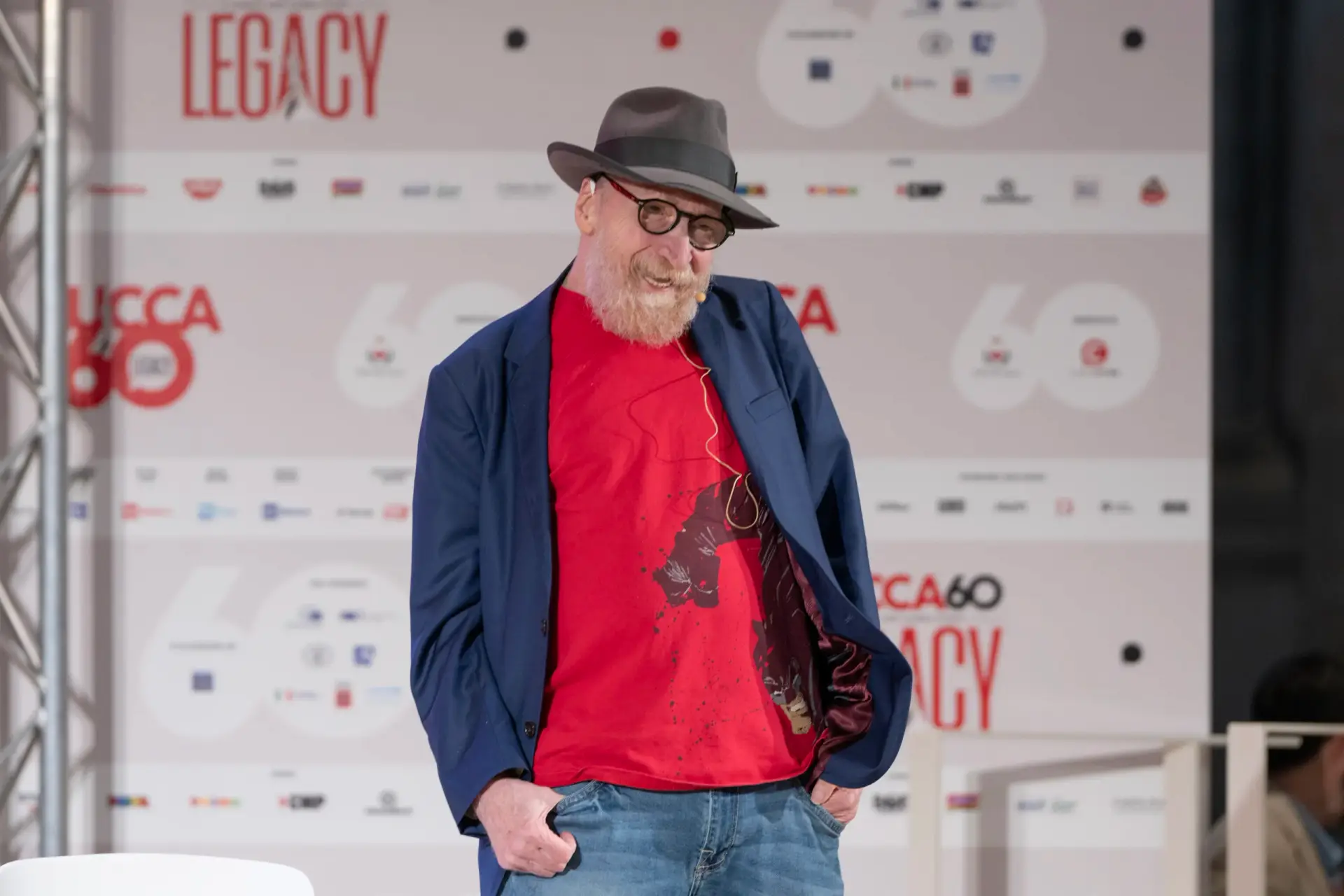
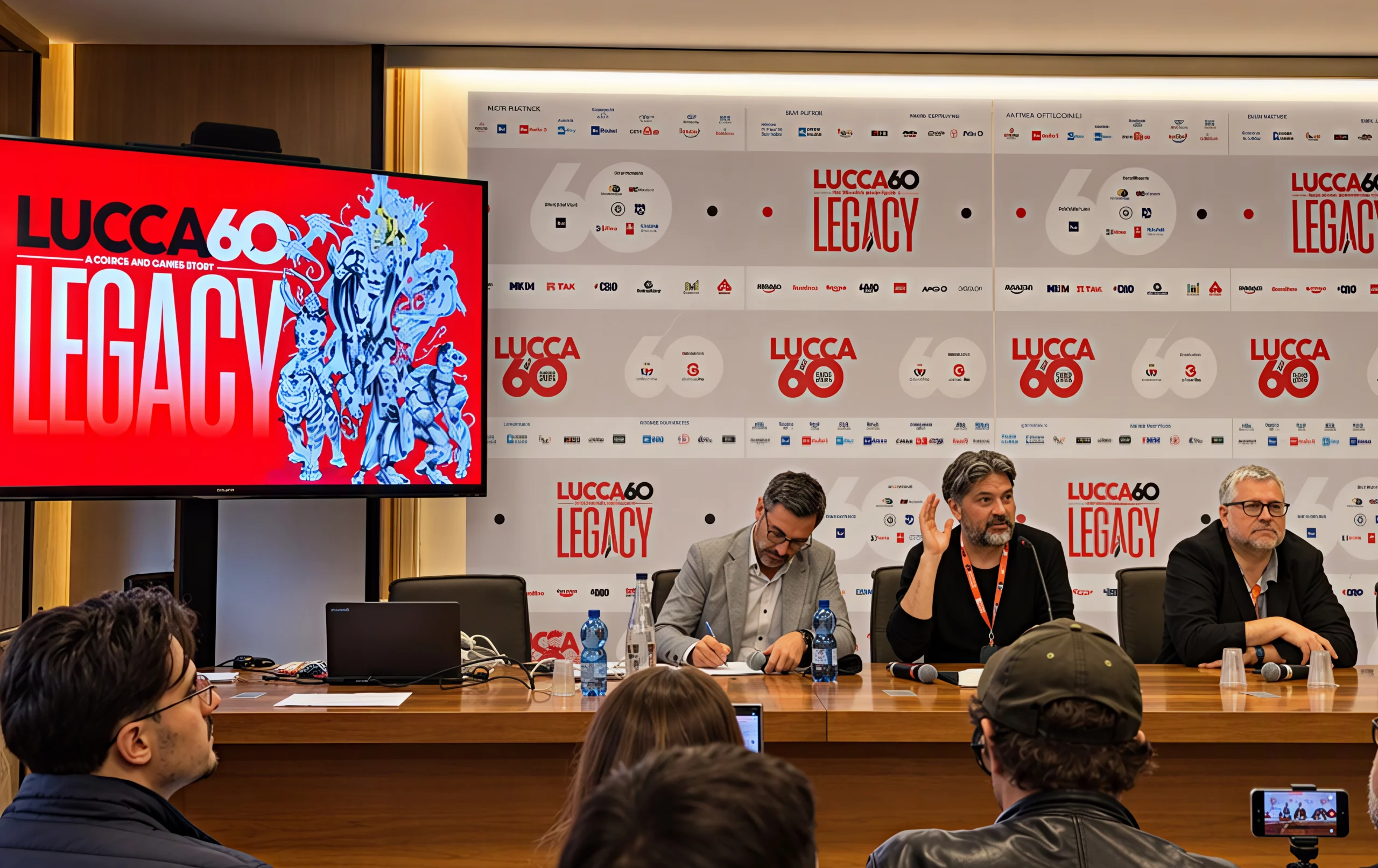
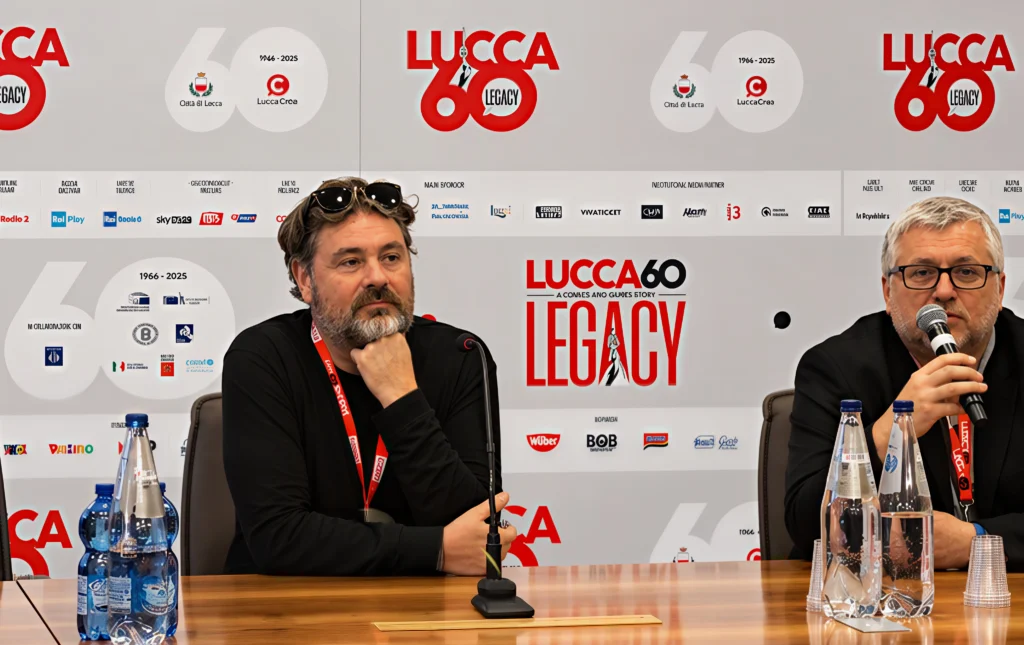
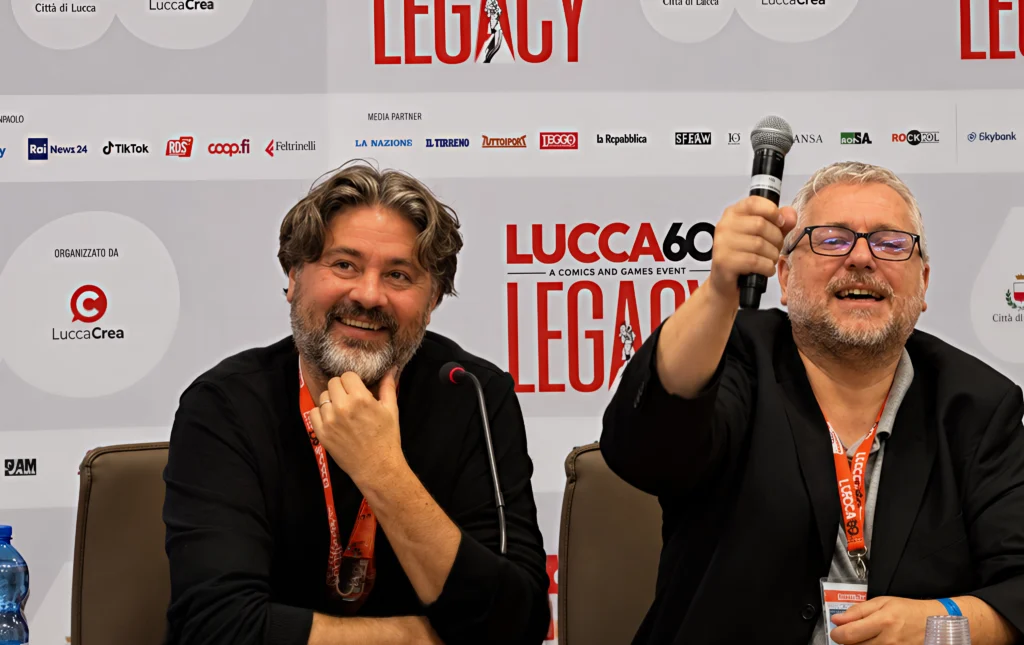
LUCCA: An intense, brilliant hour, rich in thought-provoking ideas and marked by a distinctive rhythm—sharp wit, laughter, and profound creative clarity. On October 29th, the session featuring Jonathan Hickman at Lucca Comics & Games proved to be one of the most successful events of the entire festival. The American writer—renowned for his monumental runs on Fantastic Four, Avengers, the Secret Wars saga, and his revitalization of the X-Men with House of X/ Powers of X—captivated the audience as he explored key themes from his career, the world of cinema, and contemporary storytelling, all while maintaining a refreshingly self-deprecating tone.
The Interview: Q&A from the Session
Q: A question about your narrative and visual approach: your works are frequently filled with diagrams, charts, and summary sheets. Is this an inherent part of your design style, or does it serve a specific purpose?
A: It’s actually a bit of a ruse—a trick, if you will—to pack even more narrative elements and world-building into the story. It’s a kind of shortcut. Comics today have taken a decidedly cinematic turn; they aim to provide a fluid and dynamic visual experience where text is heavily condensed to make room for high-impact imagery. These charts allow me to preserve that visual impact without sacrificing the density of the story.
Q: In your short comic book story where you appeared as the protagonist, you struggled to find an ending for your own work. What is your actual relationship with the conclusions of stories? How do you navigate things, especially at Marvel?
A: That story was actually a joke—an inside gag shared with all the other writers present! The truth is, I already had the ending ready. I never start a story without knowing exactly where I’m headed. I believe it’s essential to have a strong opening, but it’s just as important to know for certain what the final destination will be.
Q: Your stories almost always have a cosmic or geopolitical scope and rarely take place in strictly urban settings. Given your interest in moral themes, would you ever be interested in tackling an urban-focused run on a character like Daredevil—exploring his tormented relationship with faith?
A: No, I wouldn’t particularly care to work on Daredevil. And that’s not because I don’t appreciate the character, but because my writing tends to operate on a massive scale, driven by grand themes rather than the micro-psychology of an individual. That said, I always try to weave a strong moral element into the stories I tell; I believe it’s a fundamental component.
Q: The film Avengers: Doomsday is coming out soon, and it draws heavily from your run on the Avengers comics. What are your thoughts on what’s been created, and were you involved in the creative process?
A: I have the privilege of being involved and consulted in the creation of these films. Specifically, the production team and the Russo brothers ask me to read scripts and documentation regarding what they’re developing so they can get my input. Sometimes they agree with my observations, sometimes they don’t, but they treat me incredibly well.
Q: With the Krakoa era, it felt like you had said everything there was to say about the mutants. Now you’re writing Midnight, a new title tied to the X-Men universe—what do you feel you can still contribute to these characters?
A: Obviously, I never would have taken on the assignment if I weren’t confident that I could do an excellent job. I feel like I’ve said everything I had to say about characters like the Fantastic Four or the Avengers, but that’s not the case for the X-Men. Krakoa represented a specific vision, but this new phase with Midnight is completely different. It’s truly exciting to be able to work with the X-Men again.
Q: Avengers: Secret Wars will be based on the comic book event of the same name, which you wrote. Do you think the transition from the page to the big screen risks causing the viewer to lose the power of their own imagination?
A: I don’t believe the audience will lose anything, nor will the power of imagination be diminished. In fact, I think our role as comic book creators is to stay 5 to 10 years ahead of film productions, so that we can continue to inspire these massive, multi-million-dollar blockbusters. It will be very interesting to see what the future holds.
Q: (A question from Caffè Nerdiano) In your comics, we often see mad scientists, deities, or politicians pursuing a ruthlessly utilitarian vision for the “greater good”. How much of this pragmatic perspective comes from you, and how much is simply a narrative device?
A: In reality, I’m a romantic! You see me wearing this “mask” of pragmatism only because I have to adapt to today’s world; it’s a reflection of a contemporary society that forces me to put on this formal attire. But my son (he has his son stand up in front of the audience, drawing laughter from the crowd) can confirm that he is far more analytical and pragmatic than I am! I’m more of an emotional “crybaby”, though I know how to wear a mask of pragmatism when necessary—even if it doesn’t belong to my true nature.
Q: Regarding your initial vision for the Ultimate Universe and Spider-Man, did the final result stay true to your original plans, or did things change along the way? And what should we expect from the Midnight universe, compared to the Ultimate experience?
A: This time, the structure is completely different. Midnight was conceived from the very beginning as a very long run. With Spider-Man, I had decided to sign on for only 24 issues before moving on to other projects; then, Marvel announced the end of that line, which came as a bit of a surprise. The Midnight universe, on the other hand, was created to continue for as long as we enjoy writing it—and as long as readers keep buying it.
Q: In your work as a “world-builder”, a recurring interest in power dynamics and history—specifically the history of the United States—constantly emerges. Where does this fascination come from?
A: I suppose the old adage holds true: those who do not know history are condemned to repeat it. The importance of the past has always resonated deeply with me. Besides, I’ll be turning 55 in March—I’m old! In terms of my own timeline, history carries significant weight for me. My life is clearly split between the era of the Cold War and today’s globalized world—a world where you no longer have to rigidly choose a side, as we are all interconnected. Growing up and maturing within this context fascinates me. Interacting with talented young artists who have no idea what life was like during my era makes me reflect; I often find myself looking back to the past. I don’t know if it’s an obsession or simply a case of experience influencing my art, but that’s just how I work.
Q: Are you satisfied with how the X-Men saga concluded after you left the title?
A: (Hickman lets out a long, theatrical sigh, looks at the audience, and replies with bitter irony): “I really enjoy working for Marvel Comics… I think it’s a fantastic company!” (laughter from the room). Jokes aside, I had a clear vision of where I wanted to take the plot; unfortunately, it wasn’t possible to carry it all the way through, and yes, that stings a bit.
Q: How much does the contemporary world influence your scripts? Do you think your characters have something to say about the global dynamics we’re currently experiencing?
A: What makes a story truly interesting is that it should never be didactic or pedagogical—it shouldn’t stoop to telling the reader what to think, or what is right or wrong. Doing so strips away the ambiguity that makes a narrative great. The polarization and singular perspectives we see today drain the appeal from storytelling. One of my “superpowers” as an author is the ability to tell a story through multiple points of view—to argue a position strongly, and then, just as effectively, to argue the opposing side. My goal is to pose questions to the readers, not to provide pre-packaged answers. With the X-Men, for instance, two opposing factions emerged among the readers based on their own beliefs, and that’s fantastic. My job is to create the book and put it out there; it’s then up to the readers to do with it what they will.