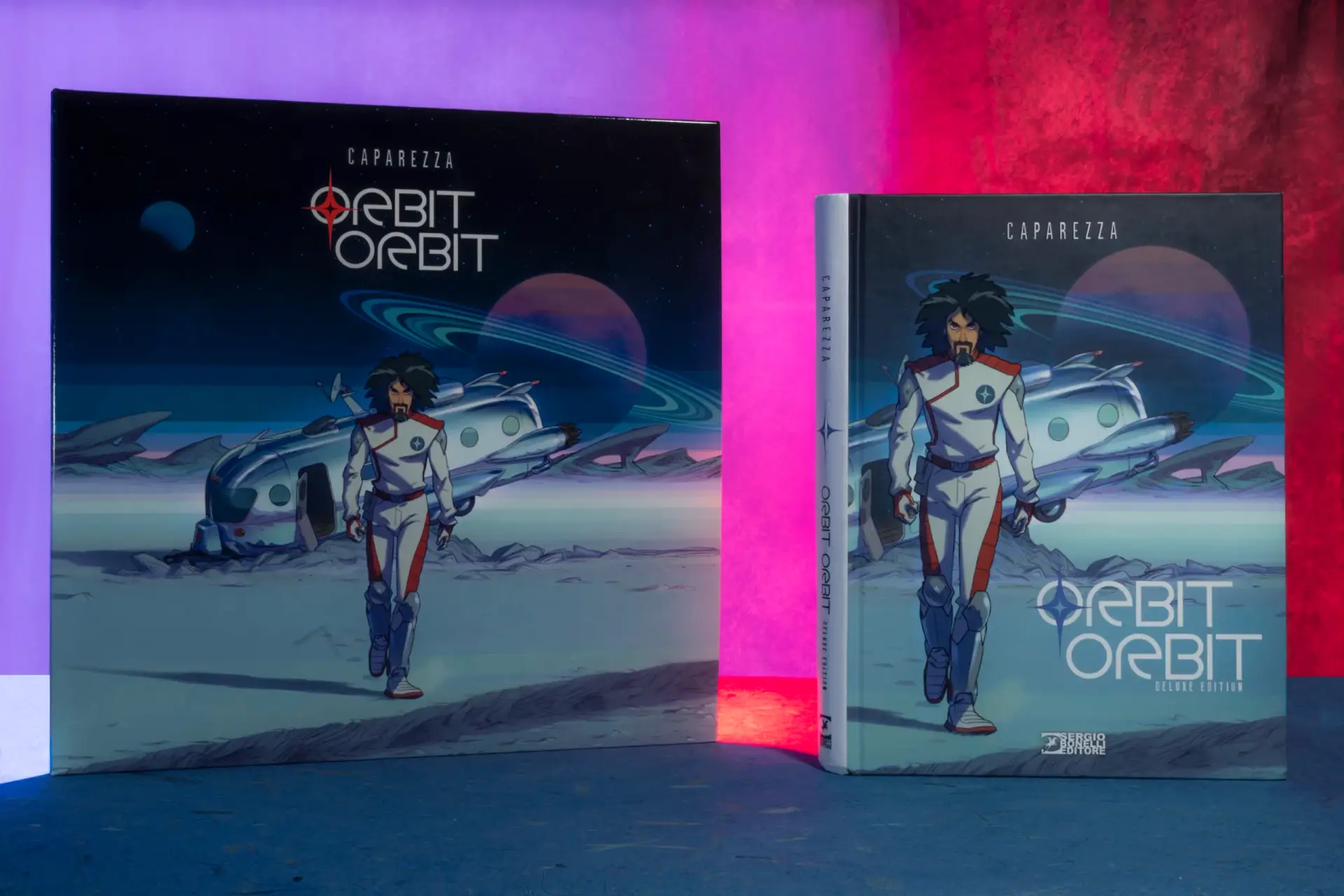
We have reached the first anniversary of Orbit Orbit, the ninth studio album by Michele Salvemini—better known as Caparezza. How has this latest “offspring” fared? Exceptionally well, in fact.
Blending music, comics, and autobiography, Michele Salvemini has crafted a multimedia experiment of rare ambition. The record is compelling, while his debut as a comic book writer leaves an intriguing question: how much further can Caparezza grow as a storyteller?
With platinum record status, a sold-out debut for the accompanying comic book, a number-one spot on the charts during its launch weeks, and accolades from the world of comics—including the Premio Coco—the project has proven to be far more than just a standard musical comeback.
But these are merely figures, medals, and trophies to display on a shelf. While such achievements are certainly well-deserved, what remains for us—the audience—once the spotlights fade? What remains is a multimedia experiment of rare beauty—a work in which music and comics do not merely coexist, but actively seek to complete one another. We are left with a version of Caparezza who lays himself bare through the persona of a cosmonaut, transforming his lifelong passion for “speech bubbles” into a profound reflection on creativity, freedom, and the possibility of a fresh start. Above all, what remains is a record that deserves to be heard for what it truly is, independent of the surrounding fanfare.
Musically speaking, there is very little to fault in Orbit Orbit—or, to put it more precisely, there is a great deal to appreciate. The album navigates a landscape of electronica, hip hop, progressive influences, and orchestral flourishes, constructing a sonic universe that perfectly aligns with the space-faring journey it recounts. It is not merely a matter of incorporating synthesizers and cosmic atmospheres to establish the project’s identity; the sound itself becomes an integral part of the narrative.
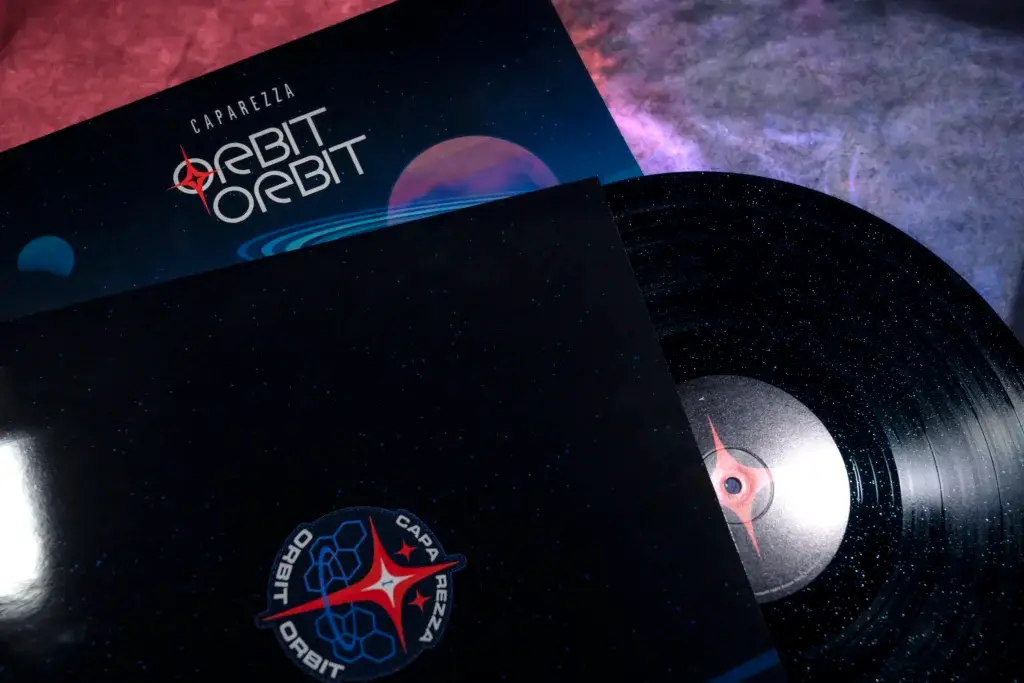
The opening track, Fluttuo, orbito (I Float, I Orbit) transports us into a suspended space—a realm seemingly devoid of gravity—while Il pianeta delle idee (The Planet of the Ideas) leads us into the most unpredictable terrain of the journey: the mind. Ideas are not static objects to be gathered, but rather restless, shifting presences that constantly threaten to slip away. The music mirrors this instability, giving shape to a train of thought that never follows a straight line.
With Io sono il viaggio (I’m the Journey), the journey takes on a more personal dimension. It is no longer just a means to reach a destination, but it becomes the destination itself. While the concept may appear simple on the surface, it gains profound significance when viewed through the lens of Caparezza’s entire career: arriving at a specific point matters less than who one becomes in the attempt to get there.
Then enters Darktar—a figure migrating from the world of comics into music and brings with him one of the most compelling shadows in the work. This character embodies the negative, self-victimizing side of the human experience—that inner voice capable of turning every challenge into a life sentence. He serves as an effective antagonist precisely because he is not merely an external enemy: he is something the protagonist must confront within himself.
The emotional core of the record arrives with A Comic Book Saved My Life. From the very title, Caparezza makes it clear just how significant comic books have been in his life. This is not merely a tribute to nerd culture, nor a nostalgic celebration of the characters that accompanied us in childhood. Instead, the comic book becomes a refuge—a survival tool—offering the chance to inhabit different worlds when the real one becomes too difficult to face. The track chronicles the artist’s relationship with this passion across various stages of his life. Musically, it features one of the album’s most compelling ideas: a dialogue between a hip-hop foundation and electronic textures, bolstered by a sample of the song Le chemin by the Rockets. The second verse, in particular, opens up a further perspective: comic books are not just gateways to other narrative worlds, but also a medium through which one can discover new musical languages. Here, a passion for imagery intersects with a passion for electronic music, demonstrating how one interest can spark others and how creativity is constantly nourished by cross-pollination.
Perhaps this is the moment where Orbit Orbit best explains itself: there is no clear-cut separation between what we read, what we listen to, and who we are. Every discovery can serve as the starting point for a new exploration.
Immediately after, Il banditore (The Town Crier) disrupts the established rhythm with a different kind of energy. This homage to Enzo Del Re—an artist with a distinct rhythmic and vocal identity—serves as a reminder that sound can also be physical, a gesture, a repetition, or words transformed into percussion. Onomatopoeia, so central to the language of comics, finds a natural musical translation here. It is one of those moments where the two mediums converge without the need for explanation.
With Autovorbit, the journey picks up speed once again. The faster pace and electronic solutions convey the image of a mind that never stops producing movement, while Curiosity (Beyond the Glow) reaffirms curiosity as the driving force of existence. The presence of astronaut Maurizio Cheli’s voice helps make the connection between science fiction imagination and real-world exploration more concrete.
Gli occhi della mente (The Eyes of the Mind) instead moves on more ambiguous ground. The sampling of Delirio—performed by Gianni Morandi—introduces a reflection on perception and the boundary between what we imagine and what we consider real. It’s a theme that runs through the entire project: the mind can be a place of salvation, but also a space in which we risk losing ourselves.
One of the most significant tracks is Come la musica elettronica (Like Electronic Music). Here, the reflection extends to the relationship with time, age, and the past. Nostalgia can be a resource, but also a barrier if it prevents us from recognizing the possibilities of the present. The song seems to suggest that growing up doesn’t mean denying what shaped us, but rather learning to embrace it without being trapped by it. This is a particularly fitting consideration for an artist who has built a career on constant transformation. Caparezza is no longer the same as he was in his early years, and he doesn’t have to be. His journey demonstrates how important it is to embrace change without losing one’s identity.
With The NDE, the journey takes on a more introspective quality, while Pathosfera stands as one of the album’s most emotionally dense moments. If the cosmos is the setting where the protagonist seeks freedom, the “pathosphere” is the space where he must rediscover his capacity to feel emotions. Reason, analysis, and control are not always enough; to truly understand oneself, one must return to engaging with one’s emotions. The track gains even greater significance when viewed within the personal journey recounted by Salvemini—a journey marked, among other things, by hearing difficulties. Without reducing the song to a mere autobiographical account, one can interpret this emotional quest as an attempt to rebuild a connection with the world through a different kind of sensitivity.
Cosmonaufrago (Cosmocastaway) brings us back to the figure of the traveler, but not that of a hero returning triumphant from a grand endeavor. The cosmonaut is also a castaway—someone who has traversed space, lost their bearings, and must now find a new way to navigate. Returning does not erase what occurred during the journey; on the contrary, it is precisely the experience of the unknown that makes a new level of awareness possible.
The album concludes with Perlificat—an expansive, choral finale that transforms creativity into a collective act. Following such a deeply personal body of work, the inclusion of numerous voices and orchestral elements shifts the focus beyond the individual. Imagination may originate within a single person, but it is not destined to remain there—it can become something to be shared.
Overall, Orbit Orbit is an album that draws its strength from the coherence of its vision and its ability to translate an intimate journey into a sonic universe. Some tracks make an immediate impact, while others require time and repeated listens. Yet, it is precisely this multifaceted nature that makes it so compelling: not every piece is designed to function as a standalone, isolated unit, rather each element contributes to a broader narrative.
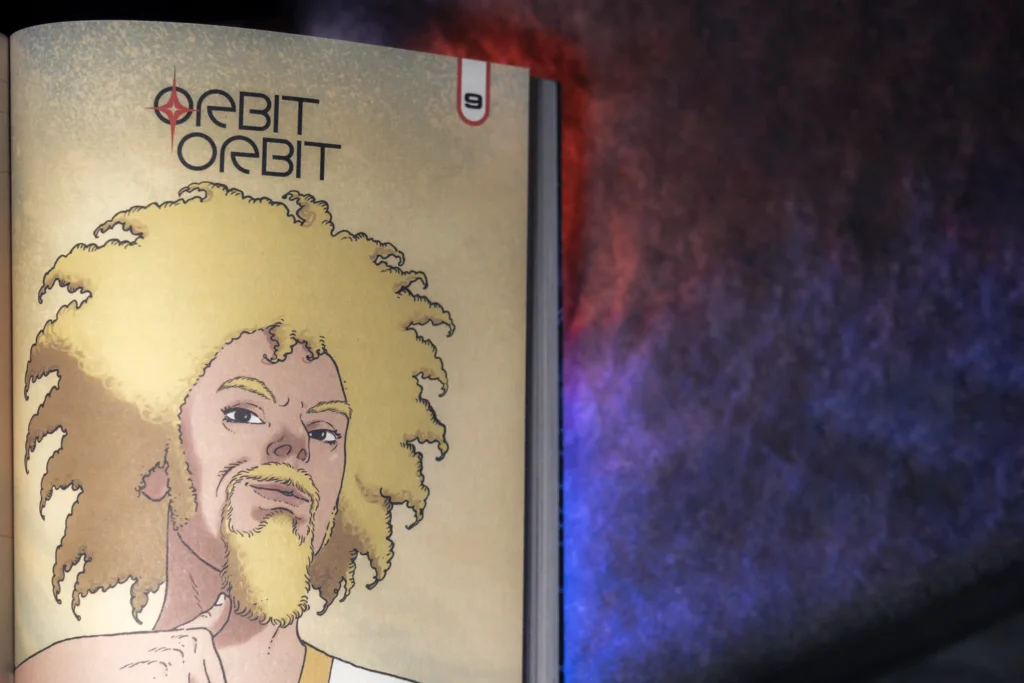
This brings us to the other half of the project: the comic book Orbit Orbit, published by Sergio Bonelli Editore. Written by Caparezza himself, it accompanies the album on a dreamlike, science-fiction journey that dramatizes the artist’s own creative process. The protagonist navigates the space between reality and imagination, confronting obstacles and encountering figures that mirror his own fears, contradictions, and his quest to rediscover inspiration.
The project is also notable for the contributions of numerous professionals from the Italian comic book industry. The interior pages are illustrated by Sergio Gerasi, Riccardo Torti, Nicola Mari, Marco Nizzoli, Renato Riccio, Stefano Tamiazzo, La Came (Laura Camelli), and Yi Yang. The cover is the work of Matteo De Longis, while the coloring was handled by Daria Cerchi, Filippo Beretta, Daniele Caramanico, Chiara Fabbri Colabich, Yi Yang, and Antonio Campo—a diverse team that brings a variety of visual sensibilities to the story.
This plurality is a key aspect: Orbit Orbit is not merely a musician’s attempt to explore a new medium of expression, but it is a collective endeavor in which Caparezza’s narrative vision converges with the expertise of artists who specialize in storytelling through imagery.
The story is good and it features a recognizable imaginative world and develops themes consistent with those found on the record. The protagonist, the space journey, and the figures encountered along the way weave a narrative in which the author’s personal obsessions and passions are easily discerned. Furthermore, the option to read a chapter and then listen to the corresponding track makes for a particularly compelling experience: the music expands upon the comic, while the comic offers new ways to interpret the music.
However, upon finishing the book, I felt something was missing—not so much in terms of ideas, but rather in terms of narrative maturity. This is an important distinction. It is one thing to possess a rich imagination, a collection of intriguing insights, and a personal story to tell; it is quite another to successfully transform all of this into a narrative that strikes a truly convincing balance between character, pacing, development, and resolution.
For years, Caparezza has demonstrated an extraordinary ability to build worlds through words. Across his albums, he has brought to life complex characters, metaphors, settings, and narratives—often using music as a vehicle to unify disparate tones. Yet, writing a song is not the same as writing a comic book. A song can rely on repetition, rhythm, vocal delivery, and the immediate impact of a verbal image; by contrast, a comic must contend with the arrangement of panels, the management of visual time, and the need to construct a narrative progression that functions effectively on the page.
Ultimately, this comic serves as an intriguing debut, though it cannot entirely shake the impression that it is the work of an author still finding his footing in a new medium. Perhaps this is its primary limitation—but also its starting point.
Let us draw a comparison with Caparezza’s first album. Throughout his recording career, there are tracks that have left an indelible mark on the public’s memory—songs still sung and cherished today—while others have traversed time in a different way. However, it would be a mistake to attribute this disparity simply to a difference in quality. A work is heard when it is first released, but it continues to live on through the transformations of both its audience and its creator. The Caparezza of his early days is not the same as the one we see today. Over the years, Michele Salvemini has shifted his perspective, his language, his interests, and the way he chooses to tell his own story. His artistic evolution has inevitably altered our relationship with his earlier work as well. What once seemed revolutionary might now strike us as raw or immature; what we once perceived as a limitation may now reveal itself as a valuable record of a specific stage in his growth. This is not a fault of the song, nor of the Caparezza of the past—it is simply how time functions when viewed through the lens of art.
It is with this same perspective that I approach his first comic book. The assessment—if we want to call it that—that I offer of Michele is the same one that could be applied to any author working in a new medium for the first time:
“It’s a good start, but I want to see where you are in a few years. I want to see how you mature not just as a songwriter, but as a storyteller.”
I would have preferred to encounter Caparezza at the stage of his ninth comic book rather than his first. This is not because Orbit Orbit is a work to be dismissed, but because his musical career has led me to expect a level of structural craft and narrative depth that here are inevitably still in the process of developing.
It is an unattainable wish, of course. One cannot skip the first work to arrive directly at the ninth, nor can one expect an author to have already reached the point they might attain only after years of experimentation. Furthermore, there is a fundamental difference: Caparezza does not need to prove he can write comics to justify his musical career. This comic book stems from a long-nurtured passion that has finally taken shape as a concrete project. It would be unfair to judge it as if it were competing with his own discography.
I believe the best way to understand Orbit Orbit is to recognize that it is, first and foremost, a work directed toward Michele himself, and only secondarily toward the public. The cosmonaut’s journey is a quest for inspiration, as well as an attempt to reconnect with his own creativity. Music and comics become two tools for navigating a difficult period, rediscovering a passion, and imagining new possibilities. In this sense, the endeavor holds a value that transcends any judgment of an individual song or a single comic panel. Caparezza has taken something from his personal sphere and transformed it into a work that can be shared, offering the audience a chance to enter his universe through two different mediums.
It is not necessary for every creative choice to resonate with everyone in the same way. A project this personal may derive its strength precisely from its capacity to allow for diverse interpretations, without requiring every listener or reader to arrive at the exact same conclusion.
Is all that glitters gold? To be honest, no. But perhaps it is silver. And that is not necessarily a flaw. Sometimes a work’s value lies in what it promises, the paths it opens, and the questions it leaves in its wake.
Orbit Orbit is a successful, ambitious project, brimming with insight. The album demonstrates just how capable Caparezza remains of reinventing his own language, while the comic book opens a door into a territory he has yet to fully explore. In terms of music, he offers a level of certainty built over years of hard work. His foray into comic-book storytelling, by contrast, is a work in progress—a path worth following, though one that shouldn’t be judged with undue leniency, nor with any rush to reach a definitive verdict. Tastes are fluid; they shift within us, and they vary among us. The ways in which we listen to a record, read a story, or recognize the value of a work are constantly evolving. What might seem like merely a promising start today could, tomorrow, prove to be the foundational piece of a more mature and self-assured body of narrative work.
Who knows—perhaps in the future we will have the chance to reflect on and discuss Caparezza’s new stories, comparing this debut to works that do not yet exist. We may see Michele Salvemini grow increasingly confident in his command of the comic-book medium, drawing upon the experience he has gained in music without being constrained by it. For now, all we can do is wait—and, of course, hope that the journey continues. Because if Orbit Orbit has taught us anything, it’s that the destination only matters up to a point. Sometimes, the most important thing is simply the continued desire to set off.