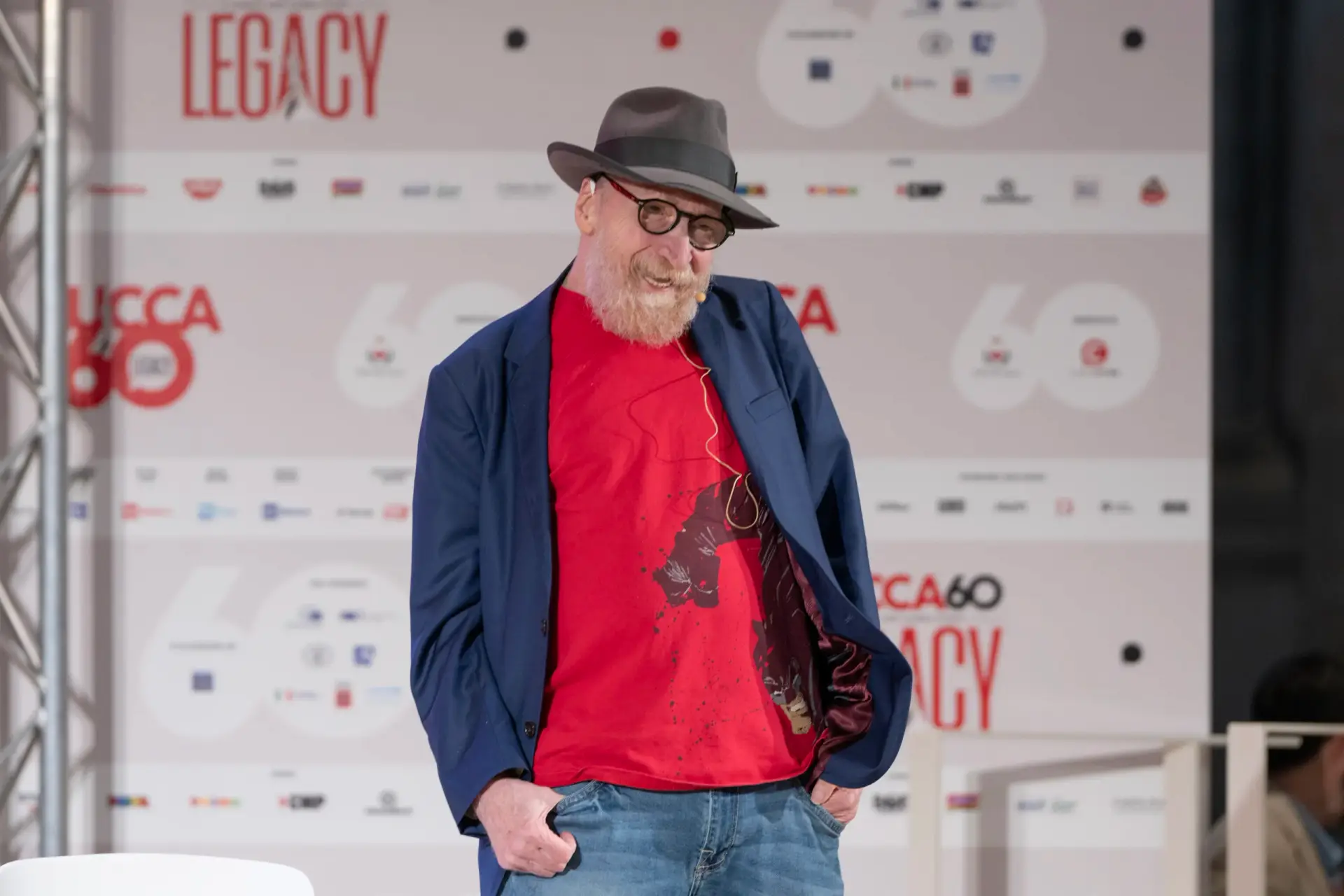
This year, Lucca has chosen legacies as its central theme, and to mark the 40th anniversary of Frank Miller’s career, a special panel dedicated to him was held. Miller retraces his creative journey from Batman to Daredevil through the lens of noir cinema, and including a special collaboration with Dave Gibbons. He discusses how stories are born and why certain characters continue to speak to him, even decades later.
There are creators who have written significant comics, and then there are those who—throughout their careers—have helped change the very way we conceive of the medium. Frank Miller undoubtedly belongs to the latter category.
Lucca Comics 2026 coincides with the fortieth anniversary of Batman: The Dark Knight Returns and Daredevil: Born Again. It was inevitable to revisit one of the most pivotal eras in the history of American comics—a time when Miller, alongside other great creators of his generation, was redefining the boundaries of the medium. He brought a narrative maturity, visual experimentation, and complexity to superhero stories that until then, had remained largely peripheral to mainstream comics.
The discussion begins in 1986, with those two works that still stand as a watershed moment today. Yet, as is often the case when he speaks about his own work, Miller shows little interest in merely celebrating past achievements. Instead, he prefers to share what was on his mind when he first set out to create them.
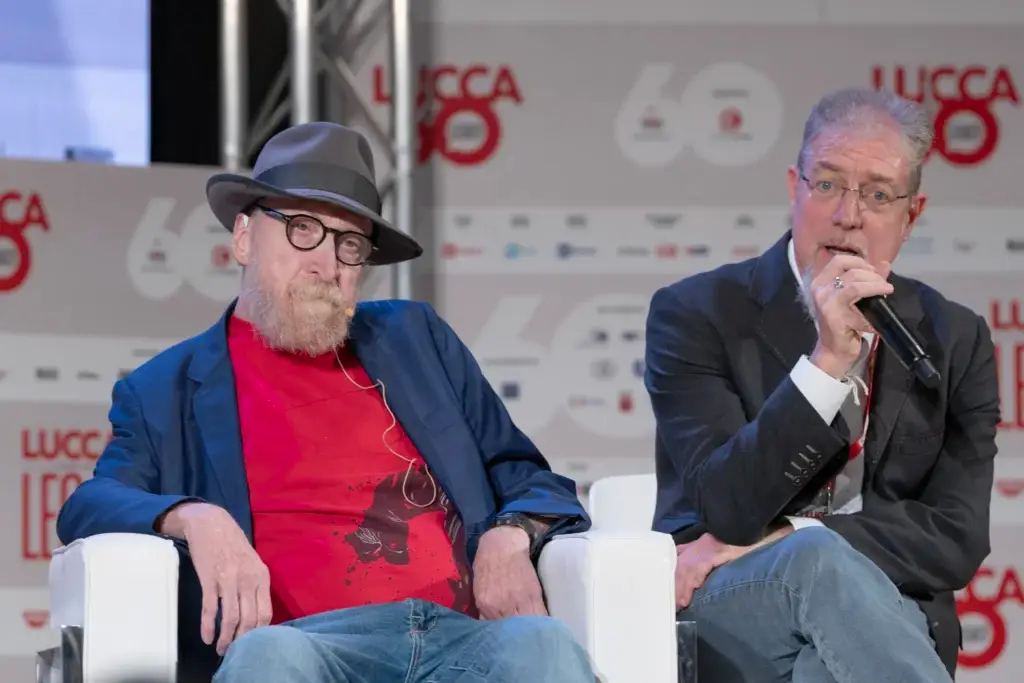
Regarding The Dark Knight Returns, Miller describes his approach as an act of demolition and reconstruction. The concept was to take a beautiful structure—now weighed down by too many accumulated additions—tear it down, and rebuild it, preserving only what truly deserved to be saved. It wasn’t about destroying Batman for the sake of it; rather, it was about liberating the character from everything that, in Miller’s view, had gradually weakened his potential. The initial concept was much darker than what the published comic would eventually become. Miller recounts having envisioned an extremely pessimistic story, with a tragic ending in which Batman would even die following a clash with the police.
The way Miller describes this process is intriguing; at a certain point, the story began to almost “talk back” to him. The character took a direction that did not entirely align with what the author had originally imagined. Batman began to suggest different possibilities, forcing him to rethink the project.
Talking to his characters is one of the most compelling aspects of his working method; an author is not necessarily someone who approaches the page with everything already decided. They can also be a reader of their own story—someone who discovers, step by step, where the characters want to go. In The Dark Knight Returns, this exploration manifests as a Batman stripped of his certainties—physically and psychologically tested—and forced to confront both his own past and a society that seems to have lost all its points of reference. Bruce Wayne is broken, challenged, and forced to rebuild himself. He is no longer just a superhero returning to action; he is a man who must rediscover a reason to continue being one.
Looking back at these reflections forty years later, it becomes clear that Miller’s intention went far beyond simply crafting another Batman adventure. He sought to interrogate the character to determine what truly remained of his identity.
The discussion then shifts to Daredevil: Born Again—another major work from 1986, created alongside David Mazzucchelli. Miller highlights its significance, particularly in terms of its visual and narrative approach. While the audio in the recording is somewhat compromised, the core idea remains clear: Born Again represented a unique experiment in visual storytelling—specifically in how the narrative unfolds through a progression of situations, atmospheres, and mental states. It is a work where the comic medium does more than just depict events in Matt Murdock’s life; it draws us into his collapse. The loss of identity, the destruction of his private life, betrayal, violence, and ultimately his slow attempt to rise again are elements that form a narrative that unfolds as much through the composition of the pages as it does through the text. Mazzucchelli’s contribution here is essential; his art evolves alongside the protagonist, tracing his descent and conveying to the reader the sense of a world that is steadily disintegrating. Miller reflects on this work with the awareness that he was part of something significant, yet he avoids falling into excessive nostalgia. His focus remains firmly on the creative process and the narrative techniques that enabled him to tell that story.
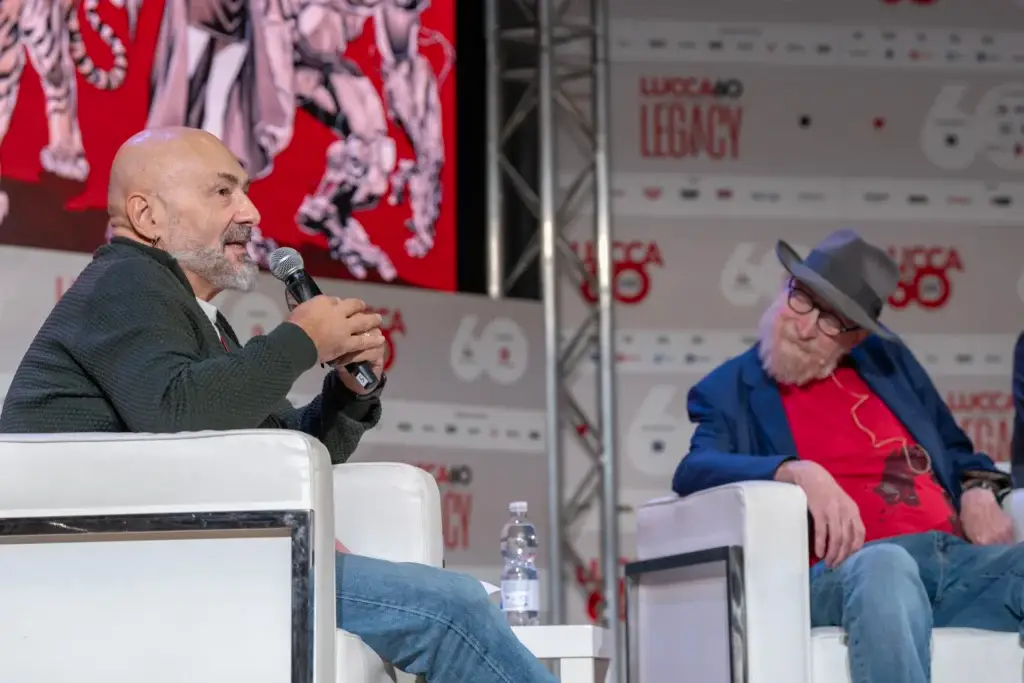
In the final portion of the recording, the conversation turns to Miller’s relationship with New York City and cinema. When asked about his familiarity with the city during those years, the author begins to explain how—in the absence of cable television—he started watching old noir films. It is a brief passage, as the recording cuts off right at that point, but it is nonetheless highly significant. Noir is a constant presence in Miller’s imagination—not merely as a genre from which to borrow atmospheres or scenarios, but as a distinct way of observing the world. Cities become hostile environments, characters navigate morally ambiguous terrain, and violence often emerges as the byproduct of a system that appears to have ceased to function. This sensibility would later become especially prominent in Sin City, though it was already evident in his work on Batman and Daredevil. Perhaps this is precisely why his stories remain so instantly recognizable: regardless of the characters involved, Miller has always sought a personal language—forged through imagery, rhythm, contrasts, and a very specific cinematic vision.
There is, however, another work by Miller that deserves far more attention when discussing his career: Martha Washington. This is where Dave Gibbons—the artist behind Watchmen—enters the picture, marking the beginning of a long-standing collaboration with Miller. What is interesting is that the creative encounter between the two did not stem from a highly structured publishing project, nor from a desire to replicate the success of their respective most famous works. Rather, it grew out of a friendship and a mutual wish to work together. To trace the origins of the project, one must go back to the the San Diego Comic Con in the summer of 1988. Miller had just finished The Dark Knight Returns, while Gibbons had recently completed his work on Watchmen. Both were at a particularly intense juncture in their careers.
According to an account given by Gibbons in a 2017 interview with AIPT, the two had begun spending time together during conventions—even outside of the official events. They hit it off, discovered a shared sensibility, and—as often happens among creators—the question arose quite naturally: why not create something together?
Gibbons recounted that Miller began telling him about a character who was still rather ill-defined. During a walk at the San Diego Zoo, the two started to imagine the possibilities for this new story. The first material Miller sent to Gibbons was anything but conventional: a narrative fragment featuring Martha on horseback and an Elvis Presley impersonator hiding in an underground bunker, holding the White House hostage and threatening to use nuclear missiles. It is hard to imagine a starting point further removed from the rigid structure of a traditional publishing project.
Gibbons produced some sketches based on those initial ideas, while Miller continued to develop the story. The artist also recalled an important aspect of their collaboration: Frank was extremely receptive to the feedback he received through the visuals. Whenever he saw something he liked, he was quick to expand the script and build new scenarios around his colleague’s visual insights. It was, therefore, a much more fluid creative process than a simple division of labor between writer and artist.
In reality, the relationship between the two went back even further. Gibbons once recounted an amusing anecdote from their Daredevil days: during one of their first meetings, he jokingly suggested to Miller that they collaborate on an issue of the series told entirely from the character’s point of view. The result would have been a comic consisting solely of black rectangles, captions, and speech bubbles—a parody of the distinct visual language Miller was developing at the time alongside Klaus Janson.
It was a joke, of course, but it speaks volumes about how closely Gibbons followed Miller’s work and the rapport that already existed between them. The Martha project, however, did not get off the ground immediately. After an initial burst of enthusiasm, the work stalled. Miller was writing scenes without a clear sense of where the story was headed and, eventually, Gibbons lost interest and stepped away from the project. The series remained in limbo for a couple of years. It was largely thanks to the encouragement of Lynn Varley—Miller’s collaborator and partner—that he decided to revisit the project, significantly shifting his approach.
The original concept was too solemn, too bleak, and too explicitly political. Miller decided to inject more absurdity, sarcasm, adventure, and fun. In short, he wanted to reclaim the joy of telling an adventure story without abandoning satire.
The result was Give Me Liberty, published by Dark Horse in 1990—a four-issue miniseries that introduced Martha Washington, a young African American woman raised in a poor Chicago neighborhood, living in a future America beset by political crises, social conflict, and a slide toward authoritarianism. Martha was not a superhero in the traditional sense; she was an ordinary person, possessed of extraordinary moral strength, who found herself repeatedly swept up in events far greater than herself. Her story would span wars, revolutions, space missions, and political upheavals—evolving into a narrative that blended science fiction, satire, military adventure, and social commentary. For his part, Gibbons deliberately moved away from the rigid nine-panel grid structure that had defined Watchmen.
Perhaps the best anecdote regarding Martha Washington comes from Dave Gibbons himself. In that same 2017 interview, while discussing their collaboration, the artist revealed that Martha had become one of his all-time favorite characters. He described her as composed, courageous, understated, and profoundly honest—a steady presence amidst a world gone completely mad. It is an image that I find particularly effective for grasping the essence of the series. Martha is not necessarily the most powerful person in the world she inhabits, nor is she someone who always fully understands everything unfolding around her. Her strength lies in maintaining her integrity even as everything else seems to be falling apart. And perhaps that is precisely what makes her such a compelling character even today.
Gibbons has recounted how their collaboration unfolded over many years, with the two periodically returning to Martha Washington between other projects. Her story, which began with Give Me Liberty, gradually evolved into a saga spanning some six hundred pages—collected in the volume The Life and Times of Martha Washington in the Twenty-First Century. It was a project that started almost as a whim during a walk at the zoo, yet it grew over time into one of the longest-running and most personal collaborations in both of their careers. Perhaps this is the best way to view the encounter with Miller in Lucca: not merely through the works that transformed the medium of comics, but also through those projects born from a sudden spark of inspiration, a friendship, or simply the desire to experiment with something different.
Because, forty years after The Dark Knight Returns, Frank Miller remains compelling for this very reason. He has never seemed interested in repeating a formula that had already proven successful. Instead, he prefers to tear things down, rebuild, strike out in a new direction—and, at times, let the characters themselves suggest where to go next.