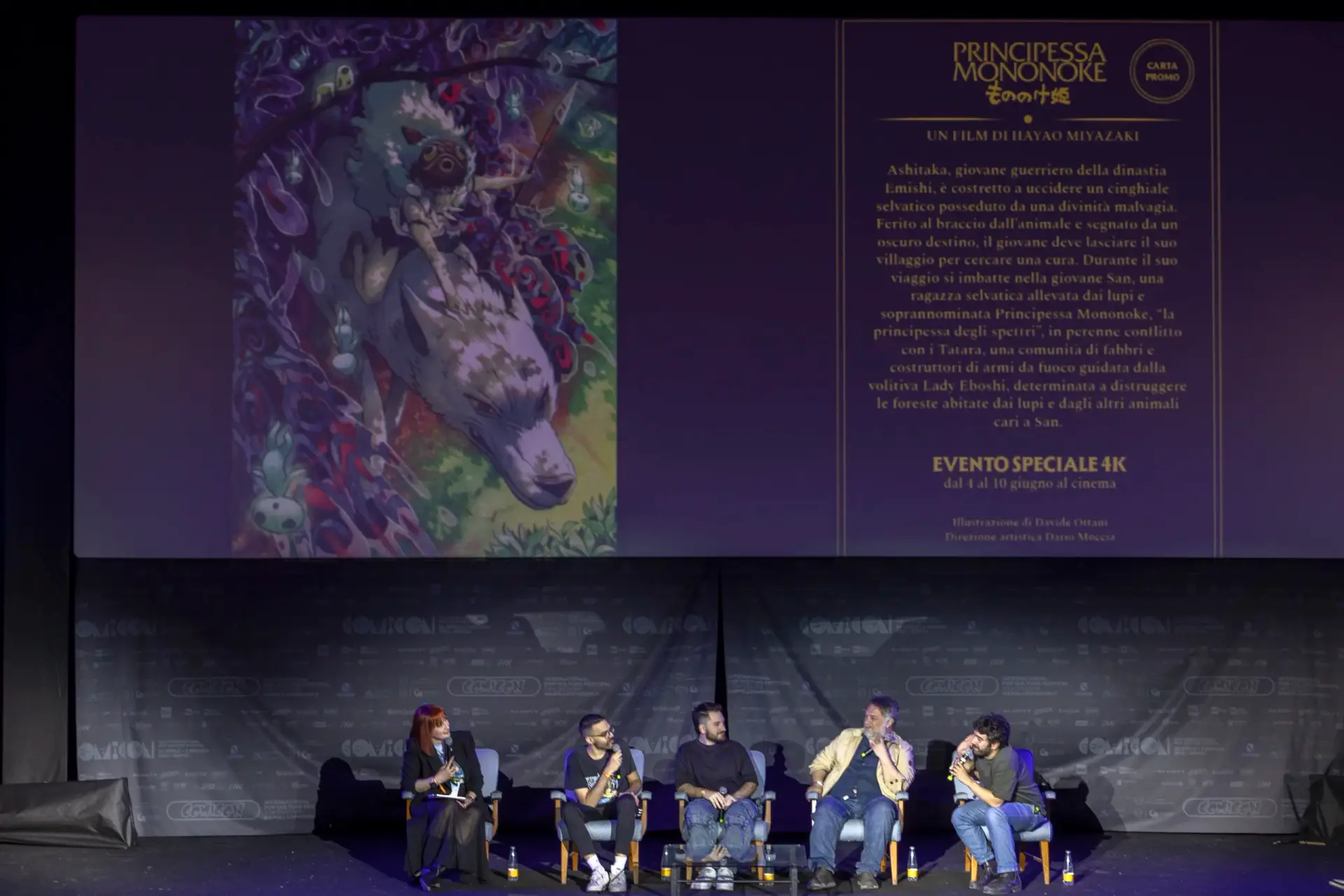
The theatrical return of Princess Mononoke in a 4K version is not merely an exercise in nostalgia, but an essential rendezvous with the history of animation. At the Mediterranean Theater during the Naples Comicon, an exceptional panel comprising Marino Guarnieri, Enrico Gamba (151eg), Dario Moccia, and Andrea Vailati—moderated by Eva Carducci—dissected Hayao Miyazaki’s masterpiece, seeking to answer a fundamental question: why is this film more relevant today than it was thirty years ago?
According to Dario Moccia, the film’s power lies in Miyazaki’s ability to eschew banal dichotomies. Watching it again today allows us to delve into the psychology of its creator—a man who transforms his own creative “unease” into a work devoid of simplistic Manichaeism regarding good and evil. It is a vision that shatters the conventions of ancient Japan to reveal a human complexity rarely seen on screen. Along these lines, Andrea Vailati highlighted how Miyazaki compels the Western viewer to take a “step back” from their own scientific rationality. The film transports us back to an era when the sacred was not an abstract concept, but a tangible presence:
“Miyazaki takes you back to that time when the sacred still existed—when gods walked the earth. Magic was still alive.”
Meanwhile, Enrico Gamba’s analysis focused on the honest—almost brutal—relationship the film establishes with the natural world. Far removed from the notion of nature as a “playground” or a purely aesthetic backdrop, Mononoke presents an environment that is simultaneously divine and violent. It is a necessary paradox for contemporary humanity, which often oscillates between the idealization of nature and the rejection of its own humanity.

For director Marino Guarnieri, the return to theaters also serves as a celebration of a specific language—that of animation—which possesses a magical quality: immortality. Despite the decades that have passed, the film presents itself to today’s audiences as a work that remains entirely “current”—a sign that, even as society evolves, the audience’s deep-seated sensibility remains unchanged in the face of undisputed masterpieces.
Guarnieri offers us a touching reflection on the film’s ending—a moment of “sublimation” in which nature reclaims its rightful space, yet without annihilating humanity. There is no military or moral triumph, but rather a necessary truce.
“There is no winner, and there is no loser—for, after all, we all make our home on the very same planet. There is no winning or losing here; there is only living.”
Ultimately, that is how it is. Miyazaki’s films may appear cryptic upon a cursory viewing, yet they invariably possess an incredible depth. The most loving, authentic, and humanistic messages of all come from a misanthrope—but his messages are meant only for those who truly know how to listen.