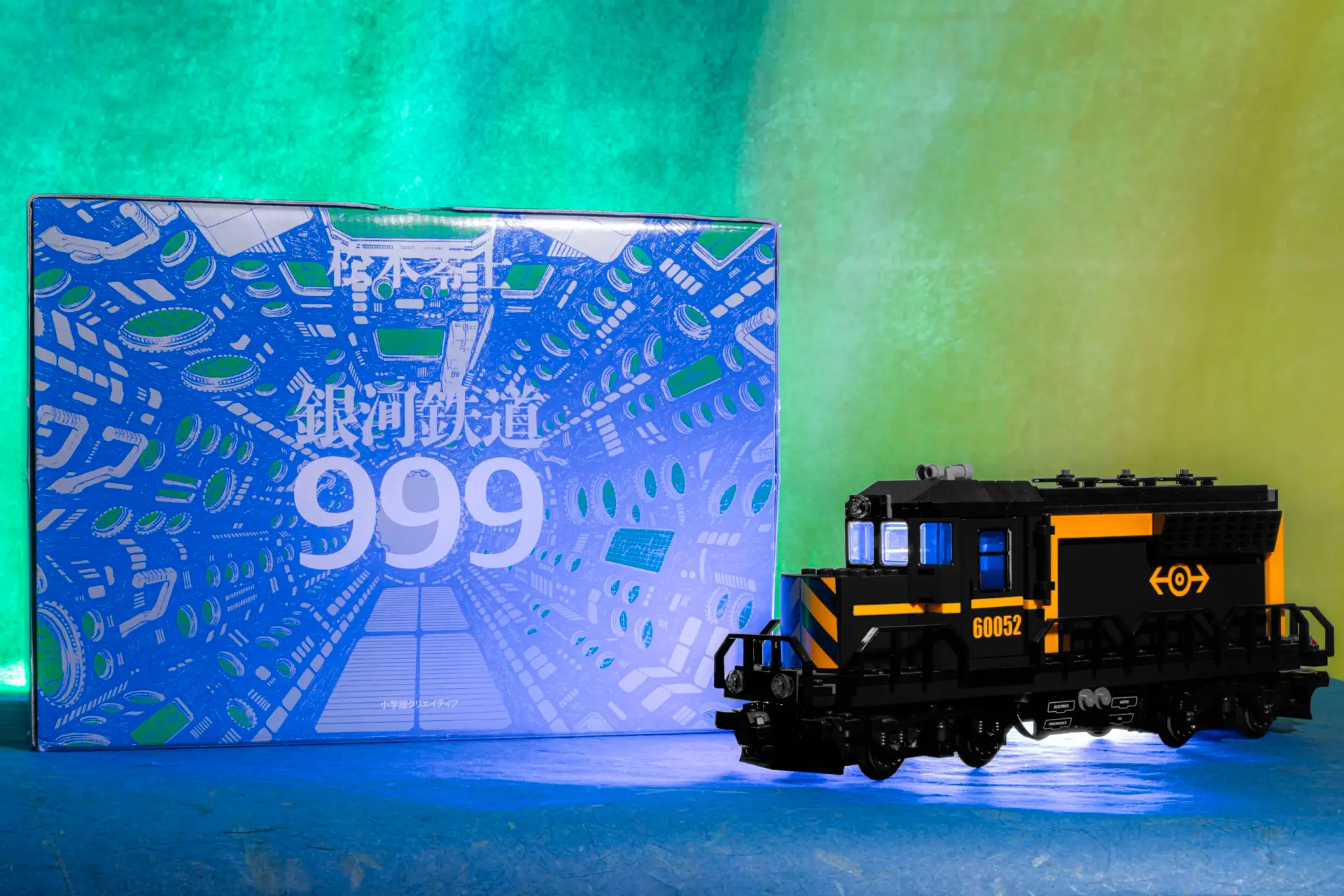
I remember it still as if it were yesterday. My teacher asked us to draw our favorite cartoons; that very same day, I saw her speaking with my parents, looking worried because I had drawn a train traveling freely through space.
For me, Galaxy Express 999 represents a childhood marked by profound themes: the desire to discover, the freedom to explore, and the need to always keep moving forward. These are traits I share deeply with Tetsuro Hoshino, the story’s young protagonist.
The story is set in a futuristic 2021 (according to the Western adaptation) or in 2221 (in the original Japanese version). Despite minor discrepancies between the various versions, the heart of the narrative remains unchanged. In this world, the wealthy can live forever thanks to sophisticated mechanical bodies, while the poor are relegated to the fringes of Megalopolis. The latter is a dystopian metropolis from which space trains depart—including the legendary 999.
Tetsuro and his mother dream of setting off for the distant “Great Andromeda” (also known as Promesium or Planet Promethium in different versions), where it is said that mechanical bodies are offered free of charge to anyone. However, their dream is tragically shattered: Tetsuro’s mother is killed by mechanical men who hunt humans for sport. Tetsuro manages to escape but collapses, exhausted, in the snow. He is rescued by Maetel, a mysterious and elegant woman who gives him a ticket for the Galaxy Express 999 on one condition: that he accompany her during the journey. Tetsuro accepts, though not before exacting his revenge upon his mother’s killers. Here, too, differences emerge across the various adaptations: in some versions, it is Maetel who spurs him toward vengeance while in others, it is a choice born exclusively from the boy’s own rage.
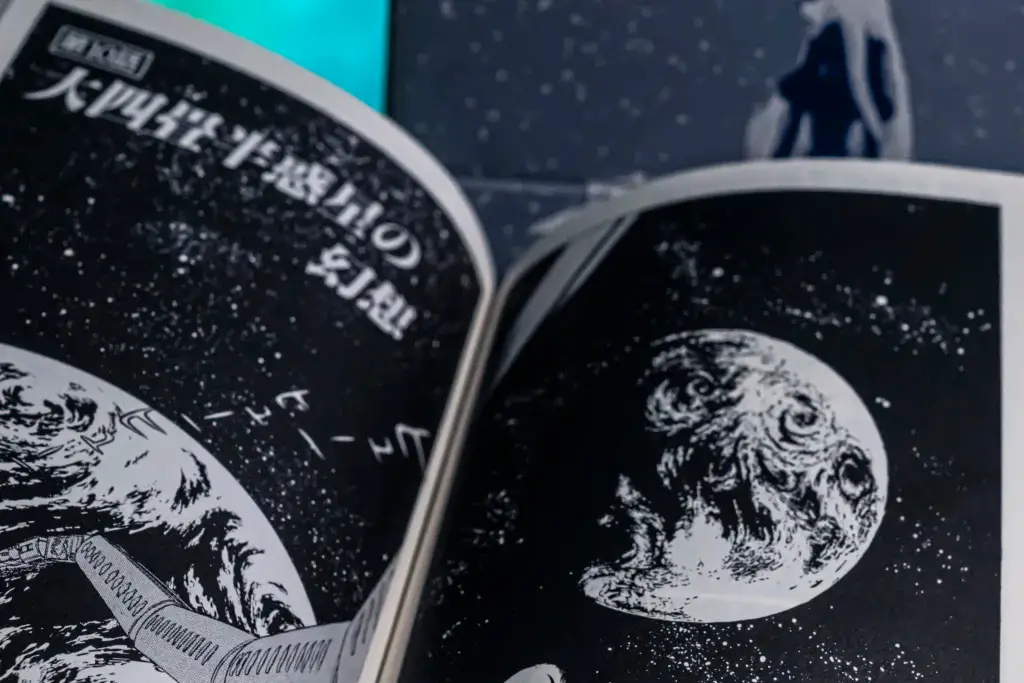
Although the work dates back to the cusp of the late 1970s and early 1980s, Leiji Matsumoto’s artistic style remains extraordinarily innovative. I remain fascinated by how the author managed to breathe life into entire worlds on mere paper, depicting planets as small, luminous marbles suspended in the cosmic void. It is a genre of science fiction where every stopover is a self-contained microcosm; cultures and atmospheres shift radically from one planet to the next. The sense of desolation, the decay, and that deeply “punk” spirit permeating the various narrative arcs never truly leave the viewer. But what strikes one most—today just as it did back then—is the ending.
WARNING: Spoilers ahead.
The conclusion lacks a lengthy build-up; instead, it resolves itself within a few explosive chapters. Upon reaching his destination, Tetsuro is disgusted by the idleness and vacuity of the mechanical men’s lives. He witnesses the suicide of a mechanized human—an event met by the other inhabitants with mockery and derision. When Tetsuro asks for the reason behind it, the dying man confesses that eternal life on Prometheus (or Great Andromeda, Promesium…) is devoid of both purpose and joy. It is further revealed that Maetel is the daughter of Queen Promethium, the absolute sovereign of the Machine Empire. The Queen seeks to conquer the universe by harnessing Tetsuro’s intellect… or at least, that is one version of the story. In another version, human bodies are utilized as an energy source for the Empire. In all versions, Maetel turns against her mother and—with the aid of her father (whose consciousness resides within the pendant she wears around her neck)—destroys the planet Andromeda.
Galaxy Express 999 is a complex work. Its difficulty lies not so much in the various translations or the liberties taken by the adapters, but rather in the themes it explores: coming of age, fear, and the temptation of an easy yet empty life—contrasted with one that is difficult, yet rich in emotion. Along the tracks of space, the protagonist matures, and—inevitably—you grow right alongside him.