All sorts of things were said about this film before it was even released. Was it all speculation? Yes and no. Let’s clear a few things up. It is well known that Nolan fixates on a subject and then racks his brain to turn it into a movie. Stating the obvious, this time it was the Odyssey’s turn; as with any artist and their work, Nolan puts his own stamp on it—perhaps a bit too much.
One gets the impression that Nolan treats the Odyssey as a grand tale of post-traumatic stress experienced by Odysseus. The film follows the protagonist confiding in Calypso, who acts more like a psychologist than a nymph. In the background, we have Odysseus’s guilt—embodied by Athena (perhaps). I say “perhaps” because the story never specifies whether the figure Odysseus sees is the real Athena or a “humanization” of the trauma that continues to haunt him. This perspective—more human than mythical—might well be convincing, but what didn’t convince us was Zendaya’s performance. The problem could be summed up in two simple words: “lacking expression”.
As you’ve likely gathered, Nolan tells the story using a non-linear narrative. However, this back-and-forth in the plot isn’t particularly bothersome. What is annoying are the unnecessary changes the film adopts.
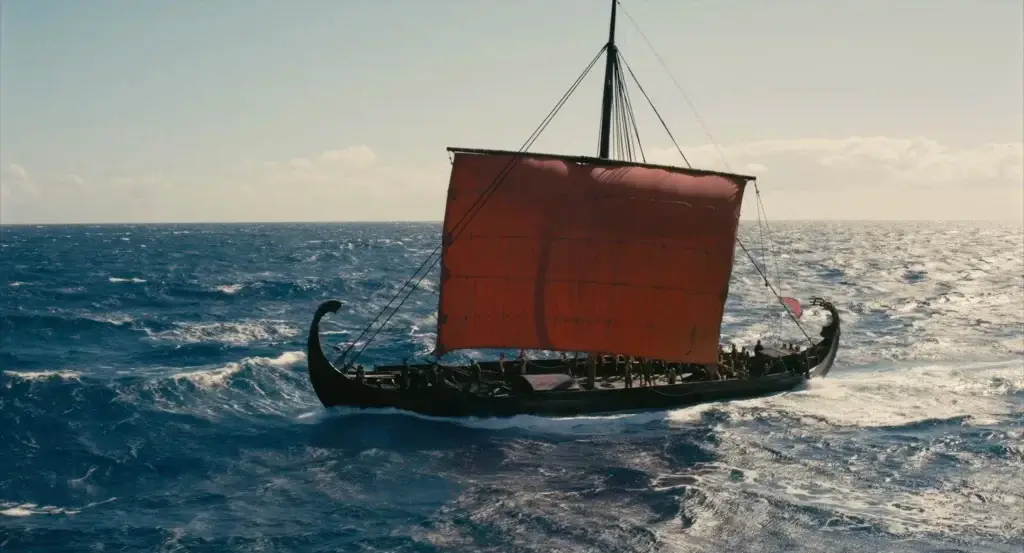
To give you an example: Polyphemus isn’t the classic Cyclops of tradition. He never stops to talk to Odysseus or his men, and the screenplay resolves this with a simple line along the lines of: “Would you stop to talk to an ant?”. Let’s just say this further “monstrification” of the Cyclops is acceptable. However, what doesn’t quite add up is that Polyphemus eats a couple of men and then goes to sleep as if nothing had happened, without anticipating a counterattack from the survivors. The film then picks up the Homeric narrative: Odysseus blinds Polyphemus and manages to escape the cave, but since the two never actually exchange words, the famous scene where Polyphemus complains that “Nobody” blinded him is missing.
There are many other minor changes in the film: having Apollo’s oxen instead of Helios’s, the encounter with the Laestrygonians, or—in the finale—Odysseus setting out on a westward journey by sea rather than by land to seek forgiveness from the gods. While I understand the visual appeal of a sea voyage toward the horizon, it would have been nice to depict the land journey as a moment of detachment and a way to move beyond Odysseus’s maritime odyssey.
Staying with the subject of questionable choices, there is the much-debated use of the word “dad”. In the original English version, Telemachus refers to his father Odysseus, as “dad” in his dialogue, rather than using the more historically appropriate and evocative “father”. Was that so hard to write into the script?
As for the dialogue, we can only say that it gets the job done, but there isn’t a single line that truly sticks with you. It lacks that iconic quote—the kind that, the moment you hear it, instantly tells you exactly which film is being discussed. And that is a shame.
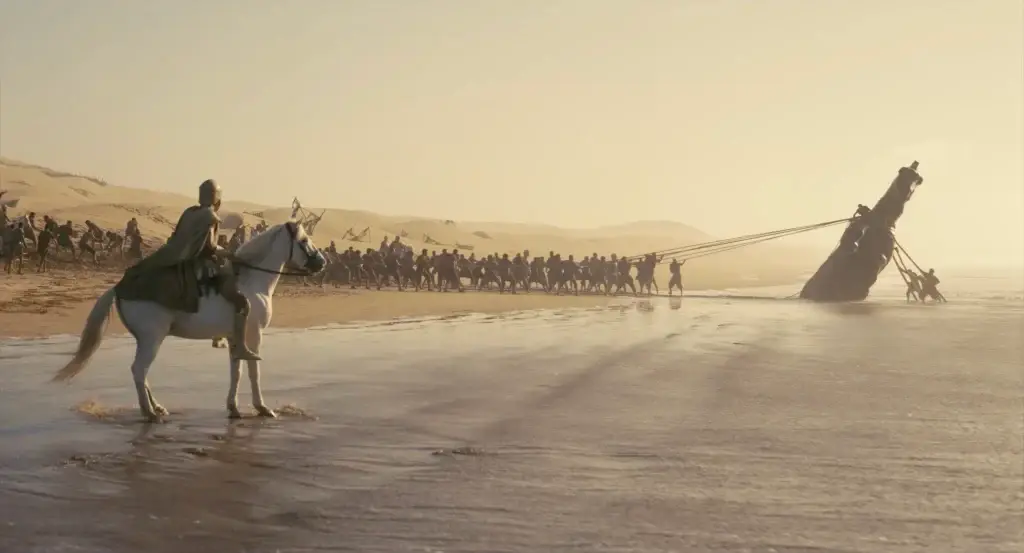
The Trojan Horse scenes are among the most human and raw moments in the film. The way Odysseus speaks about them is magnificent—how he describes the days spent inside in the dark with his men, unable to make the slightest sound. He recounts how some men drowned when the horse began to sink into the sand on the beach and sea waves seeped through the outer shell. The imagery of the Trojans dragging the structure into the city is incredibly powerful; it makes you feel the full weight and scale of that wooden construction. Yet, I burst out laughing when I saw just how many Greek soldiers emerged from the horse—I couldn’t help but compare it to a clown car!
On the other hand, we appreciated other changes that struck us as clever for this adaptation. For instance, merging the Lotus-Eaters narrative with the character of Calypso, or the decision not to let us hear the Sirens’ song, instead having us observe the scene as if we were one of the men on the ship alongside Odysseus. Seeing his face go from spellbound to etched with despair in an instant was a stroke of genius.
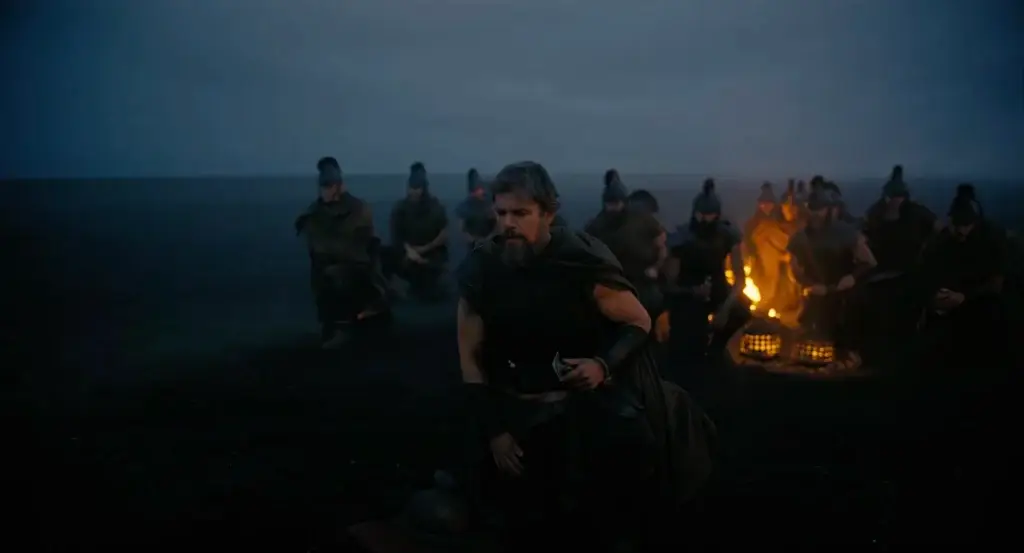
Speaking of powerful scenes, the moment Circe transforms the men into pigs is stunning. Watching her mold their faces as if they were modeling clay allows you to fully grasp the sorceress’s power. It’s a shame, then, that the script works against the staging… We also have to mention Hades: it’s a clear demonstration of how little is needed to create an incredible visual impact. Night, darkness, black sand, and just a couple of bonefires for light—it’s the best version of Hades ever.
Let’s move on to the cast—or rather, the section I’d like to title “Yes, but shame about the script”. Matt Damon makes for a perfect Odysseus: he fully inhabits the role, and you never doubt him for a moment. Anne Hathaway is convincing as Penelope, but the script doesn’t give her enough support. Casting Robert Pattinson as Antinous was another masterstroke, even though the script fails to give either him or the character their due in the final scenes. Tom Holland as Telemachus is another 50/50: he gives it his all, but the screenplay lets him down. Charlize Theron as the nymph Calypso is the film’s most harmonious element—it is just a shame she has to inhabit what is supposed to be an earthly paradise but looks more like an abandoned beach. Zendaya, as previously mentioned, failed to convince us entirely; rather than a human being, she resembled an action figure with a fixed expression. In our opinion, Lupita Nyong’o falls into the same category as Zendaya; her portrayal of Helen of Troy is completely unconvincing. Note that this is not an issue of ethnicity, but rather of how the actress interpreted (or failed to interpret) the role. In dramatic scenes, she displayed only a pale imitation of human emotion. The scene involving her daughter’s sacrifice—even though it lasts less than a minute of the film—is one of the heaviest moments, yet Nyongù’o seems barely to react. The actress appears completely out of character and seems more disengaged than anything else.
There is still much to say about Nolan’s Odyssey—much to criticize and much to praise. I would like to focus on one final aspect: Nolan himself. During filming, Nolan took into account the fact that many cinemas would project the movie with the top and bottom of the frame cropped. This results in two things:
1. The composition is rarely harmonious and features a great deal of empty space.
2. A lengthy and entirely pointless production effort.
It is an incredible achievement to have shot an entire film in IMAX 70mm, but when there are only 41 theaters in the world capable of projecting it that way, the film risks becoming nothing more than a pointless display of resources and hubris.