During a business trip, Ryan Gosling makes a new friend and moves to be closer to his friend.
Described like that, the plot is reductive and almost ridiculous. In reality, Project Hail Mary is a surprisingly rich and engaging film.
The narrative doesn’t follow a traditional timeline, but unfolds through continuous flashbacks—perfectly integrated into the plot—that cover a span of about twelve years. In effect, the film tells two parallel stories.
The “before” is made up of preparation, obstacles to overcome, and slow building relationships. It’s precisely the most human moments—the small and seemingly insignificant ones—that emerge as the emotional heart of the story; even faced with a seemingly predetermined destiny, it is these bonds that push the characters forward. However, the whole thing ends with a surprisingly emotional twist.
On the other hand, the “during” is dominated by the unexpected. Here, adaptation and reaction become crucial: every choice can mean the difference between survival and failure.
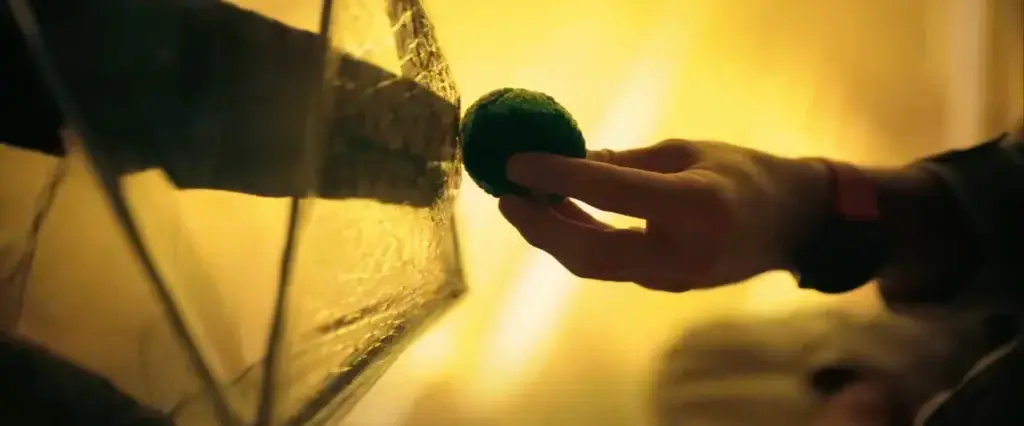
From a directorial standpoint, the film is remarkable. The costumes and set design are meticulously crafted, and the use of practical effects—such as animatronics and puppets—helps make the viewing experience more tangible and immersive. CGI is present, but never invasive or tiring; on the contrary, it is used with balance, favoring “physical” solutions whenever possible. This choice proves successful and gives the film an increasingly rare tangible quality.
Ryan Gosling is completely convincing: he manages to be brilliant in the comic scenes and touching in the more emotional ones. This is far from an easy task, especially considering that for much of the film he stars alongside a puppet. The puppet, animated and voiced by James Ortiz, becomes a true co-star. Together, the two deliver a performance of the highest caliber.
After his experiments with Dune: Part Two, cinematographer Greig Fraser returns to the forefront with infrared cameras, giving us evocative and surreal images completely free of CGI.
The scientific component is also solid: while allowing itself some typical science fiction liberties, the film maintains a credible foundation that further strengthens the viewer’s engagement.
Despite some inevitable narrative simplifications, Project Hail Mary stands out for its balance and coherence, successfully enhancing every element: writing, direction, and staging. It is a successful example of modern science fiction that demonstrates how innovation can still be achieved without sacrificing substance.