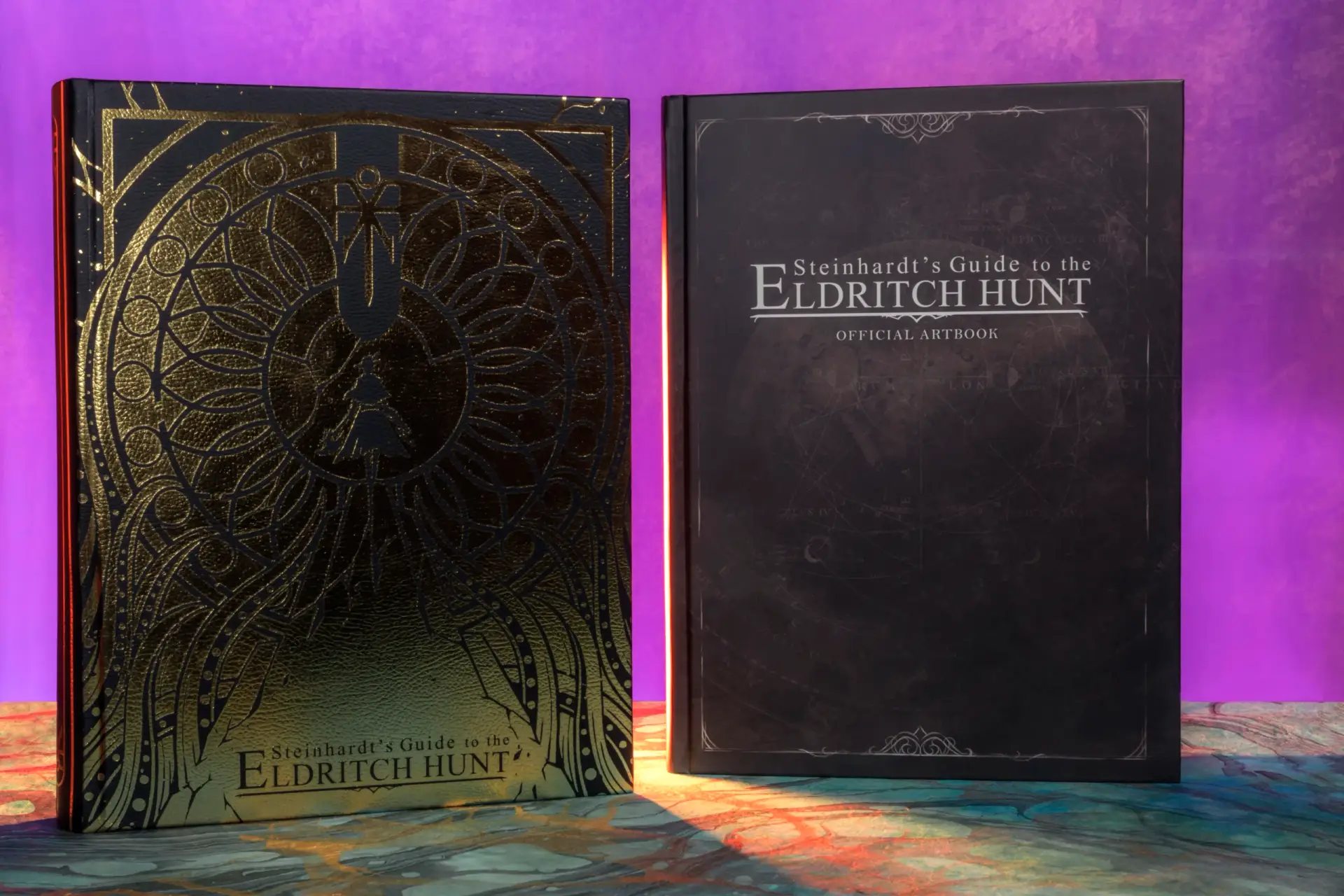
At first glance, Steinhardt’s Guide to the Eldritch Hunt appears to be a simple stylistic exercise: a third-party manual for D&D 5e that takes “Bloodborne”, sprinkles in a bit of Lovecraftian horror, and pours it all into the world’s most popular rule system. In reality, MonkeyDM’s project is far more ambitious than it seems. It is no coincidence that the project achieved massive success on Kickstarter, raising millions of dollars and garnering a great deal of attention within the RPG community.
With nearly 500 pages of content, the manual attempts to do something that few supplements truly manage to achieve: transform D&D 5e into a gaming experience with a radically different tone, yet without completely abandoning the core framework of the Fifth Edition. The result is a monumental work—brimming with brilliant ideas, but also with excesses and balance issues. It is a book that—for better or worse—possesses a strong identity of its own.
The manual is not merely a bestiary or a collection of subclasses; it is closer to a thematic conversion of 5e. Its primary strength lies in its atmosphere. The setting of Luyarnha is grimy, decadent, and oppressive. We find ourselves in a Victorian city corrupted by plagues (the Eldritch), cursed moons, and fanatical cults. The manual places a heavy emphasis on psychological horror and the constant sensation of being insignificant in the face of uncontrollable cosmic forces. In this regard, it truly succeeds in distinguishing itself from the classic heroic fantasy settings typical of D&D.
Luyarnha—the city of decaying light—is the true protagonist of the manual. It is a colossal Gothic city-state trapped between religious fanaticism, proto-industrial technology, and cosmic corruption.
The setting is built upon a powerful core concept: an apparently prosperous civilization slowly rotting from within. This is where the rulebook truly surprises because the “lore” is not merely “cool dark fantasy”; but the setting possesses a relatively coherent political, social, and historical structure.
Luyarnha began as a multicultural experiment between humans and elves. For centuries, it flourished thanks to trade, cooperation, and cultural fusion. Then came the classic dilemma of hybrid societies: ideological fragmentation. Divergent religions, moral codes, and systems of justice began to clash. It is at this juncture that one of the setting’s finest figures takes the stage: the Godless King—Reinholdt “The Yellow” Silverblood. He is perhaps the most intriguing character in the entire book: an atheist, authoritarian monarch obsessed with national unity. He outlaws religion, centralizes the state, and replaces faith with political propaganda. Gradually, he comes to believe that he himself is a deity. His downfall triggers a devastating civil war that paves the way for the force that would ultimately dominate the setting: the Radiant Church.
This is where the manual gets truly interesting. The Radiant Church isn’t simply “the corrupt, evil church”. It is a genuinely salvific religion, but it slowly becomes problematic. Its ideals are even noble—strength, hope, and the betterment of the future—but the price is steep. The Radiant faith is built upon an almost Darwinian philosophy: goodness without strength is weakness. This makes the Church incredibly fascinating, for it is neither wholly evil nor entirely reassuring. It is that classic system that likely does genuinely save the city… while slowly consuming its soul. The manual does an excellent job of maintaining this moral ambiguity.
From a mechanical standpoint, the book is incredibly rich. It introduces new races such as the Demidritch (creatures born from the union of humans and eldritch beings) and the Scourgeborn (abominations born from the curses of those who succumb to madness). Furthermore, we find fresh spins on old classics, such as Deep Dwarves, Cursed Tieflings, and Manikin (constructs). In addition to the new races, there is also a new class: the Jaeger—clearly inspired by the hunters of “Bloodborne”. As with any self-respecting sourcebook, Steinhardt’s Guide to the Eldritch Hunt offers a wealth of new subclasses: 17, to be precise. As a product inspired by Bloodborne, “trick weapons” simply could not be missing. The whole experience is seasoned with systems of madness and corruption—far more profound than the standard fare—and dozens of abominable monsters. For less experienced game masters, there are also ready-to-run adventures and extremely detailed lore.
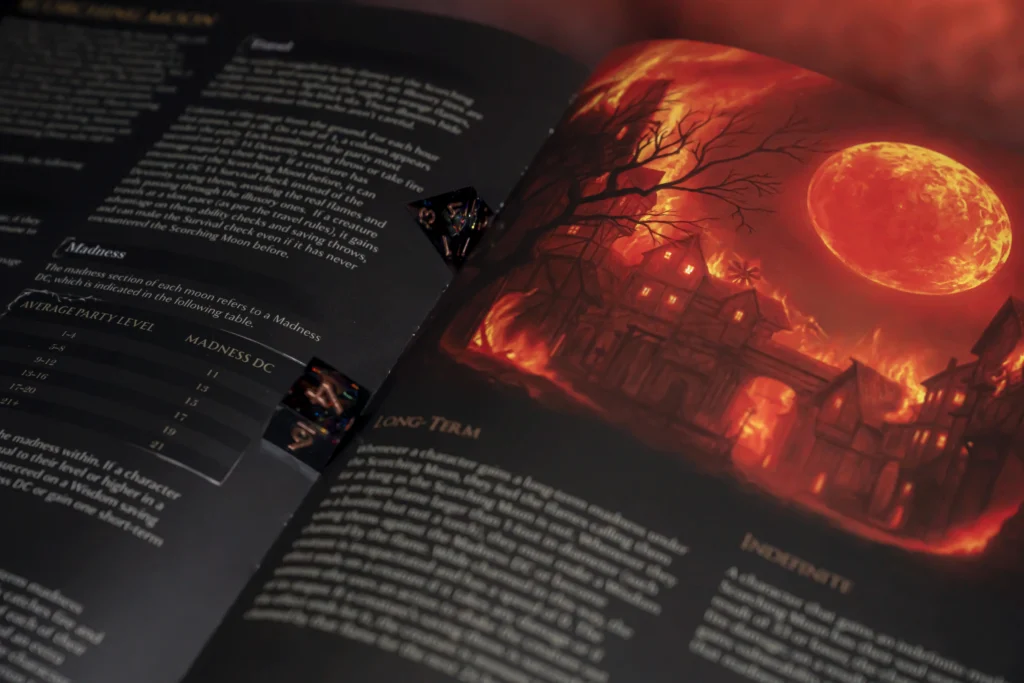
One of the most intriguing elements is the Eldritch Moon system: cosmic events that warp reality and alter the very rules of the game. These phenomena influence characters, monsters, and the narrative atmosphere alike. It features a highly evocative and original mechanic—particularly for groups that enjoy running long-term horror campaigns.
That said, this is not a perfect rulebook. The sheer volume of content can feel somewhat unfocused, and some mechanics seem designed more for “cool” factor than for actual balance. Some DMs might find the power level of certain classes, weapons, or options to be a bit over the top compared to traditional D&D. Furthermore, the extremely grim and violent tone is not suitable for every group; this supplement works best with players interested in narrative horror and tragedy, rather than classic heroic fantasy.

The Madness System starts with a solid concept, but the execution remains questionable. The insanity system is thematically perfect. The problem? In 5e, losing control of one’s character can easily become frustrating. Those who love cosmic horror—or games like “Call of Cthulhu”—tend to appreciate it greatly, whereas those who play D&D in a more heroic style tend to find it punitive and intrusive to their roleplaying experience.
In essence, the rulebook and its mechanics work best with groups that genuinely crave tragic horror, rather than just “heroic fantasy with a dark aesthetic”.
The book’s “readability” occasionally suffers from the project’s sheer ambition; while there is a wealth of ideas, they aren’t always organized in the most intuitive manner. However, the artistic impact is stunning. The illustrations, graphic design, and overall aesthetic direction are arguably among the book’s strongest features.
Ultimately, Steinhardt’s Guide to the Eldritch Hunt is a spectacular supplement for anyone looking to transform their D&D game into a gothic, brutal, and desperate horror experience. It isn’t an essential addition for every gaming table, but it is a must-have for fans of Bloodborne, Dark Souls, and cosmic horror. It is undoubtedly one of the most fascinating and creative third-party products released in recent years.