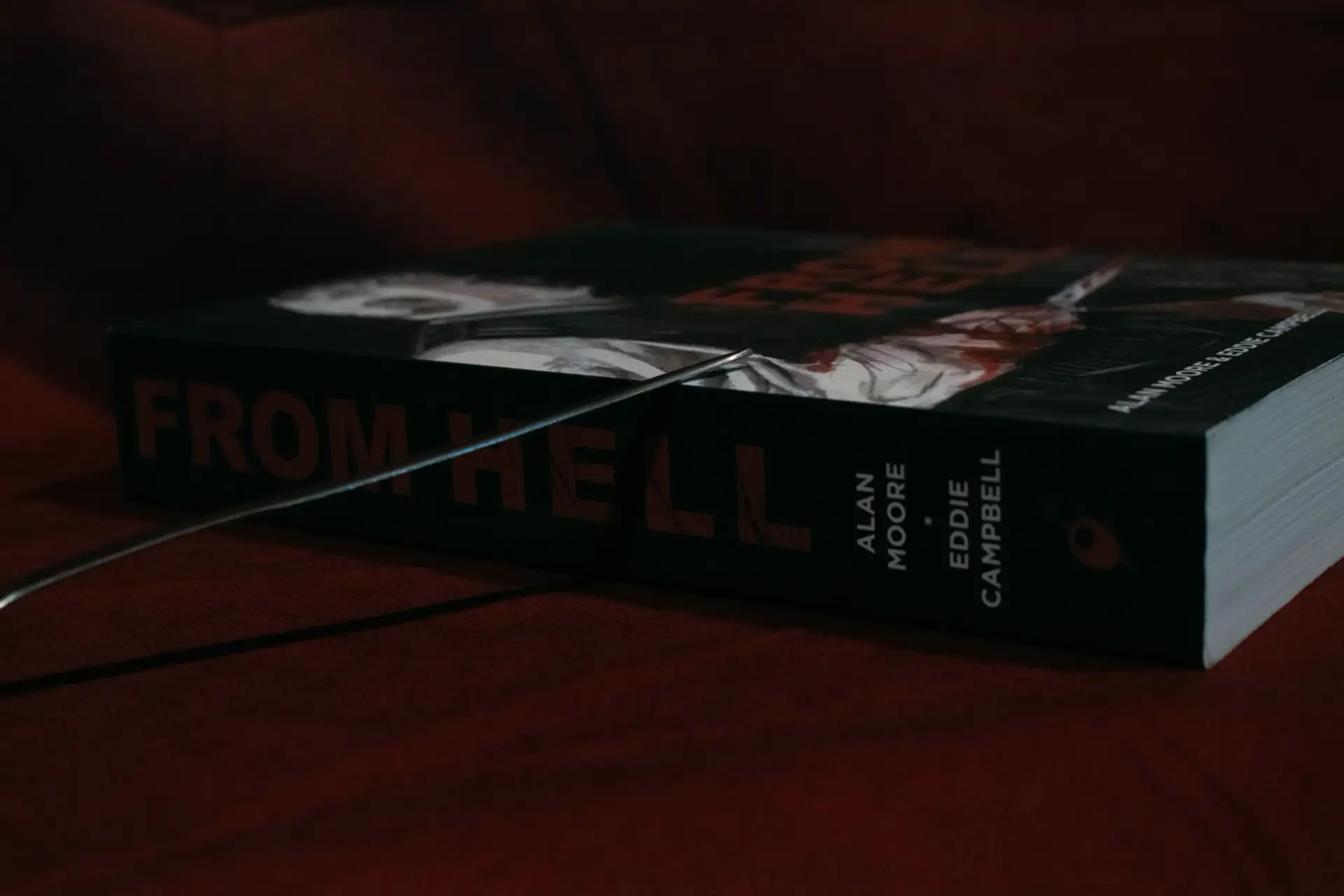
Written by Alan Moore and illustrated by Eddie Campbell, this work goes far beyond the “true crime” genre; it is a philosophical treatise on the late 19th century.
Although this work is nearly four decades old, it remains a stunning achievement—one that has not aged a day.
The premise is well-worn territory: the brutal Whitechapel murders of 1888, committed by Jack the Ripper. However, Moore makes a radical choice: he reveals the killer’s identity right from the very first pages.
The story is not about the “who,” but the “why.” We follow Gull on a delirious psycho-geographic journey through the streets of London—convinced he is performing a magical ritual to preserve the patriarchy and the social order—while Inspector Abberline desperately attempts to connect the dots within a corrupt system that has no desire to be saved.
Eddie Campbell’s artwork is fundamental to the work’s impact: a gritty, stark black-and-white. There is no polish here. The panels are dense, grimy, and filled with cross-hatching that seems to mirror the fog and blood of London. Campbell’s raw realism refuses to aestheticize violence; instead, he renders it clinical, disturbing, and profoundly human—eschewing the sensationalism typical of horror films.
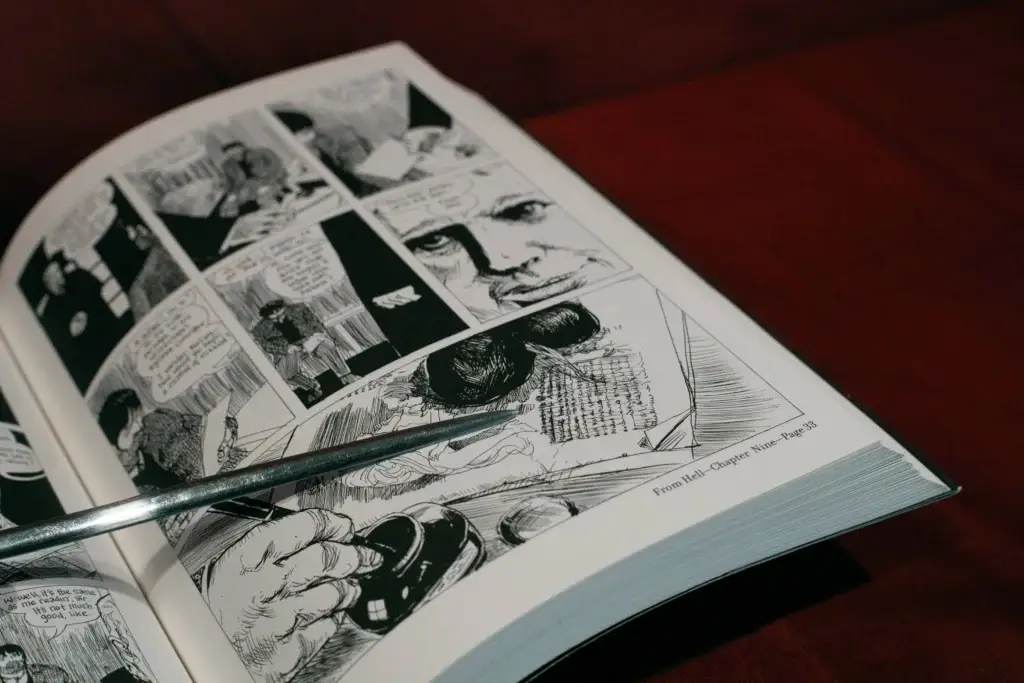
Moore has researched every minute historical detail. The complete edition includes nearly 50 pages of annotations explaining where historical fact ends and fiction begins. One of the most celebrated chapters features Gull guiding his coachman past London’s monuments, explaining how the city’s architecture serves as a map of power and magic. Moore suggests that time is not linear, but a solid structure: Jack the Ripper is not merely a killer, but the obstetrician who “delivers” the violent 20th century. As is typical of Moore, the work serves as a critique. It lays bare the hypocrisy of Victorian society: the stark contrast between royal palaces and the abject misery of Whitechapel, where women are not victims of “pure evil,” but rather of an economic and social system that has rendered them invisible.
One of the most dizzying elements of the work is Moore’s ability to link the horror of 1888 to our own modernity. Through Gull’s visions, the reader is catapulted into glimpses of the future—our present—suggesting that the blood spilled in Whitechapel is the very fiber from which the contemporary world is woven. It is an unsettling meditation on how violence evolves into myth, and how that myth, in turn, shapes reality. In this sense, From Hell ceases to be merely a comic about a murderer and becomes, instead, a chronicle of the birth of our modern consciousness—fragmented, and obsessed with the macabre.
From Hell is a dense read—at times difficult, and profoundly disturbing. It demands attention and patience, yet it rewards the reader with a depth that few other comics (or novels) have ever attained.
And let’s be honest: the film adaptation starring Johnny Depp is, by comparison, a watered-down imitation that fails to do justice to the complexity of the book.