Analyzing the live-action adaptation of *One Piece* remains a complex challenge: it is almost impossible to avoid constantly comparing it to Eiichiro Oda’s original manga or its animated counterpart. In this second season, it becomes clear that “foreknowledge” (the benefit of hindsight regarding what will unfold in subsequent volumes) served as the screenwriters’ compass, leading to narrative choices that are as bold as they are debatable.
Warning: Minor spoilers for both the Netflix series and the manga follow.
While the scene in Loguetown where Zoro acquires his new swords is adapted almost 1:1, the same cannot be said for the rest of the saga. The premature introduction of Bartolomeo—complete with an “origin story”—is baffling; after all, this is a character who doesn’t make his debut until Chapter 705 of the manga, whereas the Loguetown saga takes place entirely between Chapters 96 and 100.
One of the most debated points is undoubtedly the execution of this arc’s most iconic scene: Luffy on the scaffold. While in the source material his smile is pure and imbued with a disarming acceptance of fate, in the Netflix series, his facial expressions veer dangerously between madness and rage, losing some of the spiritual depth characteristic of the character. As for the cast, Callum Kerr’s portrayal of Smoker fails to convince from the very first minute; however, the actor gradually grows into the role and, by the end of the season, manages to become a credible presence.
Another significant change concerns the flashback involving Laboon and the Rumba Pirates. Capitalizing precisely on their knowledge of future developments, the series chooses to give this element ample screen time right from the start, transforming what was originally a fleeting allusion into a fully fleshed-out moment. Martial T. Batchamen delivers a convincing performance as Brook, even if he still seems to lack that certain “flair” we hope to see emerge in the future.
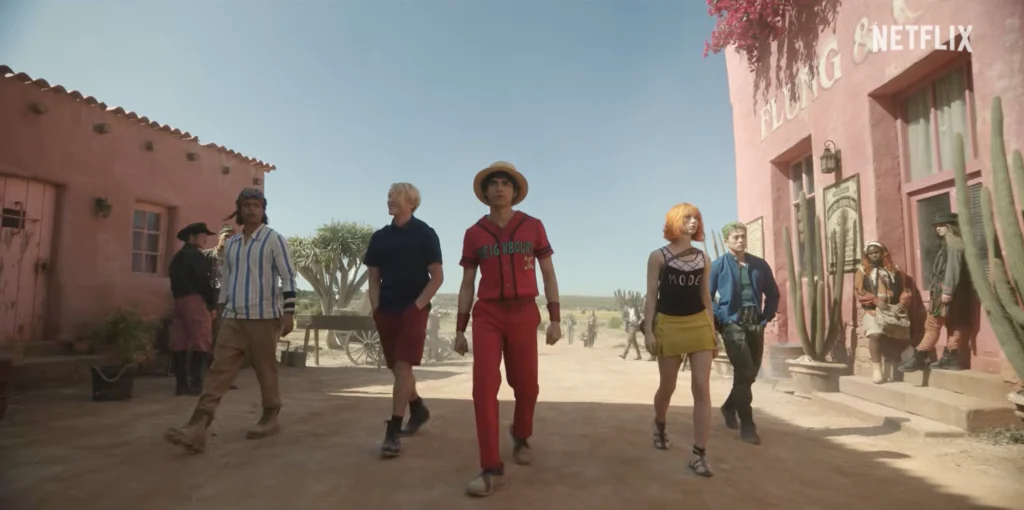
In “Little Garden,” we encounter a blend of nods to the original source material and entirely new scenes. Once again, the “compass of the future” guides the script—as evidenced, for instance, by the early introduction of the “Sun God Nika” concept.
It is here that the writing for Usopp truly shines: his doubts and fears emerge in a genuine manner, making his journey of growth feel both human and tangible.
Lera Abova steps into the role of Nico Robin with absolute perfection. She demonstrates immense potential—something we hope to see fully realized in the upcoming season.
The transition to Drum Island marks a distinct shift in atmosphere. In the original work, despite Nami’s illness, the tone feels somewhat more relaxed: Zoro effortlessly cuts through entire armies, while Chopper handles his own adversaries with complete autonomy. In the live-action adaptation, however, the narrative opts for a path of heightened drama. Everything is rendered with greater tension—yet this raises a lingering question: if the protagonists struggle so intensely against “minor” foes, how will they possibly manage to face the threats awaiting them in Alabasta? Within this context, Rob Colletti delivers a portrayal of Wapol that—while diverging from the original to better suit the script—still manages to leave a distinct personal mark on the character.
While the first season allowed every member of the crew to have their own moment of glory, this season suffers from an almost excessive focus on the protagonist. Luffy appears to be the only one truly capable of resolving critical situations, often reducing the others to mere supporting players waiting to be rescued. The enemies, for their part, are presented as “monsters” serving a purely functional role within the plot—antagonists whom the audience can detest without any moral qualms. However, as previously noted, the manner in which these foes are ultimately defeated occasionally risks leaving the viewer with a somewhat bitter taste.
Despite these alterations, the series still manages to strike right at the heart of its most pivotal moments. The scene in which Luffy defends Dr. Hiruluk’s flag remains virtually identical in both its thematic resonance and visual impact, standing firm as one of the season’s most powerful emotional pillars. Chopper’s flashback is also very faithful to the original material and manages to hit the viewer right in the gut.