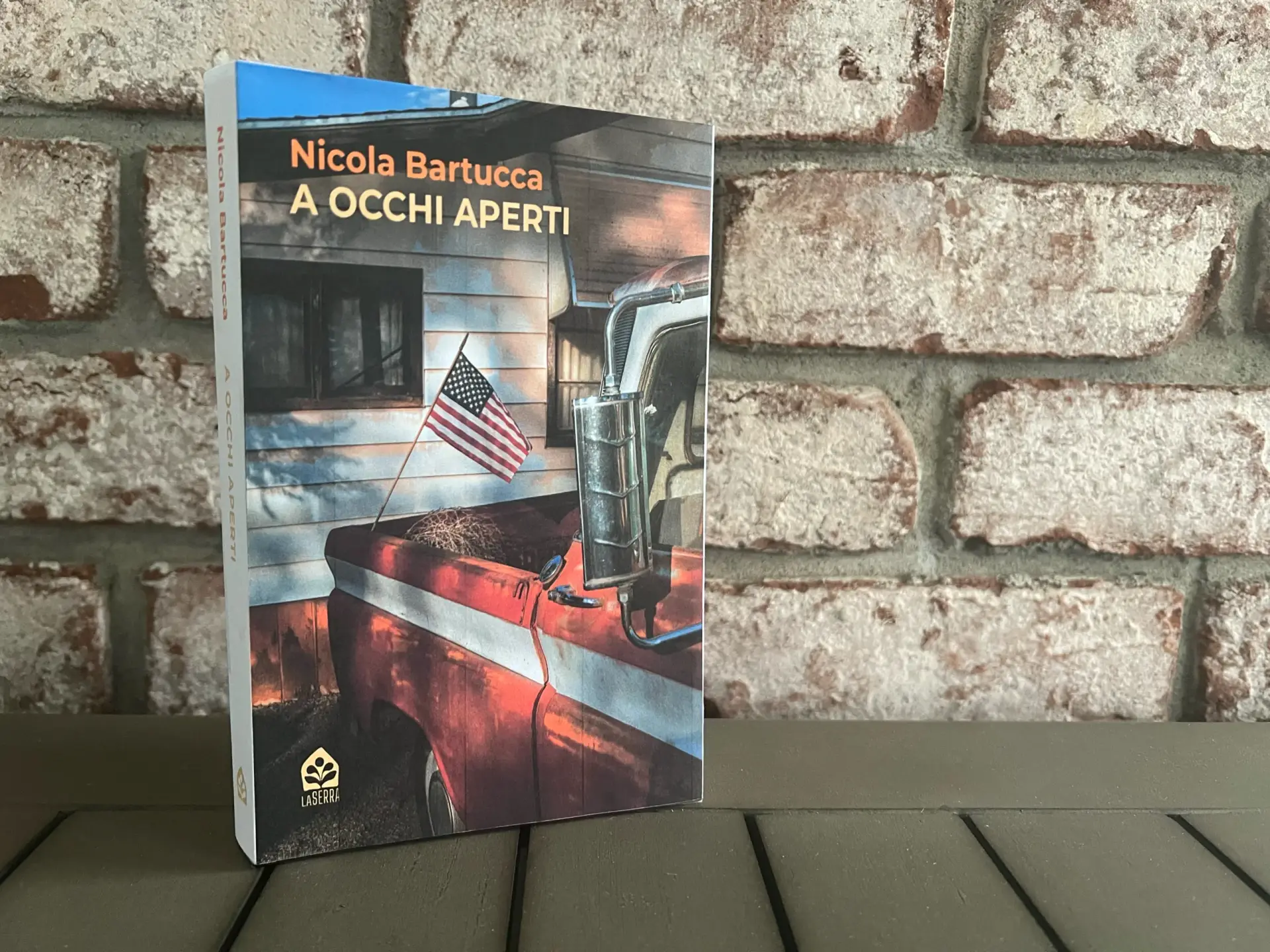
Reading this book, evoked in me a blend of nostalgia and discovery. From the very first lines of “Sogno Americano” (American Dream), I found myself transported back in time. To be precise, I found myself back at the moment of my first visit to the United States. JFK—New York’s main airport—seemed like something alien to me. The streets, the people… everything was so different. It wasn’t a matter of good or bad; it was simply different. And then, dreams and expectations collided with reality—just as they did for Luca, the protagonist of both the first and the last story in this book. It is a collision of reality with illusion, with dreams, with disillusionment, and with the fantasies we all construct around ourselves and about our own lives.
The moment when expectations give way to the unvarnished truth of things is precisely one of the strongest unifying threads running through A Occhi Aperti (With Open Eyes). In Bartucca’s stories, the characters almost always begin with a preconceived notion of the world, only to find themselves soon compelled to question it. Yet, this is not merely a case of narrative pessimism. Rather, it appears to be an attempt to observe reality without filters—through a gaze that strives to remain lucid even when everything around it descends into confusion.
The story that left the deepest impression on me is—without a shadow of a doubt—“Sunnymart”. It felt the most authentic. It is the story of routine, of repetitive work, and of that pervasive sense of being trapped in a life one never imagined turning out this way. It is not a loud or dramatic story in the classical sense, yet, that is precisely why it works: it captures a slice of everyday life that many will instantly recognize. It is the story that we Millennials need. It is a story that does not seek to offer consolation at all costs, but rather honestly conveys the sense of precariousness, suspension, and searching that defines a generation raised on grand promises, only to face a reality that proved far more complicated.
Another interesting element of the book is its structure. The stories appear to be standalone, yet as you read, you get the sense that an invisible thread binds them together. The characters are often in motion—physically or emotionally: they travel, they flee, they move to new cities, or they simply try to figure out where they truly stand in their lives. It is as if each story were a fragment of a larger mosaic, wherein the central theme remains constant: understanding who we are when our certainties begin to crumble.
A Occhi Aperti is a book that confronts you with reality. It navigates the terrain of coming of age, disillusionment, and the search for meaning. It is a narrative mosaic that comes nearly full circle, bringing the reader back to the starting point with a newfound awareness.
Bartucca’s writing style is direct and sensory, capable of shifting seamlessly between irony, melancholy, and emotional tension. He guides the reader deep into stories that seem rooted in the everyday, yet slowly reveal an unexpected depth. He does not strive for dramatic effects; instead, he focuses on details, on specific situations, and on the characters’ inner thoughts. And it is precisely in these most intimate moments that the book truly strikes a chord.
Perhaps this is the collection’s greatest merit: the ability to tell stories that vary widely from one another while maintaining a consistent narrative voice. Each story opens a window onto a small human universe composed of fragility, tentative efforts, and mistakes.
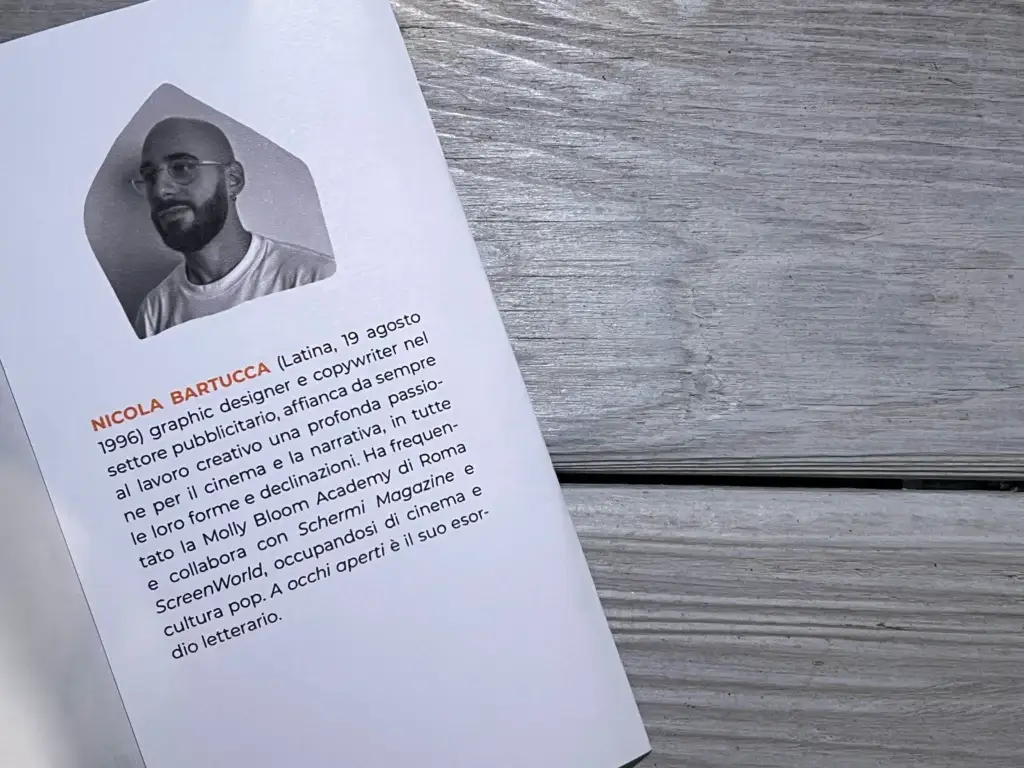
I had the pleasure of exchanging a few words with the author himself, discussing these very themes: the genesis of the stories, the characters, and the way these tales came about.
Q:
The short story “Sogno Americano” plays heavily on the contrast between expectations and reality. How much of that story is autobiographical?
Bartucca:
Not much autobiographical… what I experienced while traveling in America, every time I visited, lived there, explored different places, and each of those gave me a touch of that very same illusion. But then, after spending some time there, I also found something authentic. To some extent, it also mirrors the process that the character (Luca) undergoes, but that particular story isn’t one I lived through myself; I merely imagined it. On a podcast episode, I had heard this story about a young man… Thanksgiving was a sensitive day for the American host family he stayed with during his high school years. This was because the holiday was close to the anniversary of their daughter’s suicide. That detail really stuck in my mind, so with time… it lingered within me for quite some time and I built an entire world around it.
Q:
In the book, the characters seem to experience moments of disillusionment. What does it mean to you to “look at the world with open eyes”?
Bartucca:
To take it all in—that is, to embrace the good things, but above all, the bad ones. Because, in my opinion, it is very easy to become disillusioned if you are intelligent—emotionally intelligent—and sensitive. This world is always somewhat ready to crush you, isn’t it? Then again, I don’t know. I suppose we could branch off into a thousand psychological and philosophical directions, but fundamentally, I think there is a great deal of disillusionment in life. This book represents one of those rare instances in my life where I experienced a sensation that went even beyond mere happiness. Perhaps, until just a few years ago, I wouldn’t have even expected it to happen. Maybe, deep down, I had always wanted it (to publish a book), though I suppose I might still end up feeling disillusioned.
Q:
Many of your stories are set in the United States. What role does America play in your narrative imagination?
Bartucca:
In my opinion… I had always felt that this specific imagery served as a catalyst, allowing me to imagine even more vividly. Perhaps if I had set all the stories in my own city, or in various parts of Italy—which might have actually been easier to write about—I don’t know… but there… I experienced emotions that were truly novel—not necessarily intense, but simply new. I believe I really needed that specific scenario, also to remain faithful, anyway, to the feelings I had experienced.
Q:
Writing short stories requires a different structure than writing a novel. What attracts you to this format? And what motivated you to write these particular stories?
Bartucca:
I am a reader who primarily reads novels. However, certain short story collections I’ve read have left a truly lasting impression on me… “In State of Intoxication” (Palo Alto) by James Franco, and Tonight, This Morning, Too Soon by James Baldwin. Starting with a form like that, creating this sort of “clockwork” mechanism—albeit on a smaller, more scaled-down scale—allows me to manage the timing much more effectively. Then perhaps what drove me was the burden of writing, of narrating, of wanting to say everything… I needed to play with many characters and find the satisfaction of having said everything I felt like saying, at least in that moment… But, look, maybe now the next project is a novel. A novel, among other things, is set in my city, but ironically, I’ve been much more prolific with the short story collection.
Q:
The story set at “Sunnymart” reveals a critique of work and the alienating life we all lead to some extent. Do you think fiction can still be a tool for social criticism?
Bartucca:
Absolutely. And I think that’s the story. I don’t know if it’s better, but perhaps it’s the one most suited to the times. Because those few people who have already read the book, said it’s truly ours: the Millennials’. As if it captured a generation, because there’s this disillusioned love. There’s this ephemeral feeling, meaning the illusion of dreams and a life that moves forward by inertia. And the alienating work that—for better or worse—almost all of us do. And so I think it can still be a social critique. The problem is getting it across. In my opinion, if that story were read by all young people between the ages of 25 and 35, the book would sell 60 million copies because they would all relate to it. I’m sure of it. So yes, the problem is getting it heard.
Q:
Is there a story in the book that you’re particularly fond of or that was the most difficult to write?
Bartucca:
The last one. The last one was particularly difficult to write. The one I’m very fond of is “MiniApple”… which was the last one I wrote. But the last story, “American Dream Part Two” was very difficult. Because in reality they were notes I’d written many years ago… I took them and re-arranged them according to this structure I’d created. I wrote [the] other [stories] from scratch, working towards the end. At most, you’d rework them later, during the editing phase. But this one, on the other hand, was really difficult… In the end, I have to say I was very satisfied with how it turned out. It was also very difficult because it came from some personal things. But then I had to transform them, that is, into an imaginative reality. That one was a little more complicated, while the others were all written from scratch.
Q:
As you mentioned before, after A Occhi Aperti, you’re trying your hand at a novel. Can you tell us something about it?
Bartucca:
It’s a coming-of-age novel, so to speak. A story told in two different time periods, 25 years apart. 13-year-old boys go through an experience that will strip them of some of their innocence. Twenty-five years later, the protagonist returns to his hometown where the incident occurred, and he returns for a friend’s funeral. He’ll find himself dealing with this scar. It’s a bit between “Stand by Me” and “Sleepers”, so to speak.
Q:
A Occhi Aperti is your very first book. What’s it like publishing today in 2026?
Bartucca:
To answer this question properly, I’d have to know what it was like to publish in 1996, but it’s certainly difficult. [It’s] a very particular world. I’ve noticed that most small publishing houses are in it solely for the money. They might spot a promising product, knowing full well that the author will manage to sell those 150 or 200 copies, and simply pocket the cash and that’s it. That is precisely why I held onto it [my manuscript] so tightly—because, after all, it meant a great deal to me. By chance, I stumbled upon [the publisher] “La Serra”—that much like me, was just making its debut in the literary world. The owner is a contemporary of mine and we hit it off instantly… so, I consider myself “lucky”. I believe this is exactly the kind of debut I had always hoped for, one shared with people who matched my own level of enthusiasm. And that is truly how it unfolded—quite by chance. Otherwise, my answer to you would have been entirely different; this is a world where you have to buy yourself a brand-new pair of shoes and then wear them out all on your own. Because no one is going to lend you a hand.
Q:
Is there any advice you’d give to those who want to start telling their stories?
Bartucca:
My advice is: do it if you truly feel the need. Not because you want a chance at fame or because, pardon the expression, it’s cool. It should be done, simply, because you feel that spark inside. If you don’t have it, there’s no point in looking for it, because it’ll throw everything else in your life into disarray.