Once upon a time, there was Woodsboro. For a whole decade, horror cinema’s most famous county ruled the roost, teaching us that to survive a massacre, you had to know the rules. Then came New York, a metropolitan gamble that upped the ante with Scream VI, transforming Ghostface into a trigger-happy urban predator. Today, with Scream 7, the clocks are turned back. Perhaps too much.
In an age of requels and industrial nostalgia, the seventh installment of the saga directed by Kevin Williamson (returning to directing almost thirty years after the 1996 masterpiece) makes a bold yet conservative choice: it brings Sidney Prescott (a consistently magnificent Neve Campbell) back to the forefront. After the unfortunate production mess that saw the departure of Melissa Barrera and Jenna Ortega, this film feels like a fresh start, but also like creative writing under dictation. The result is a disorienting work, captivating when it looks back at the first trilogy, but stumbles when it tries to say something new, ending up with a more subdued and melancholic narrative than the bombastic chapters featuring the Carpenter sisters.
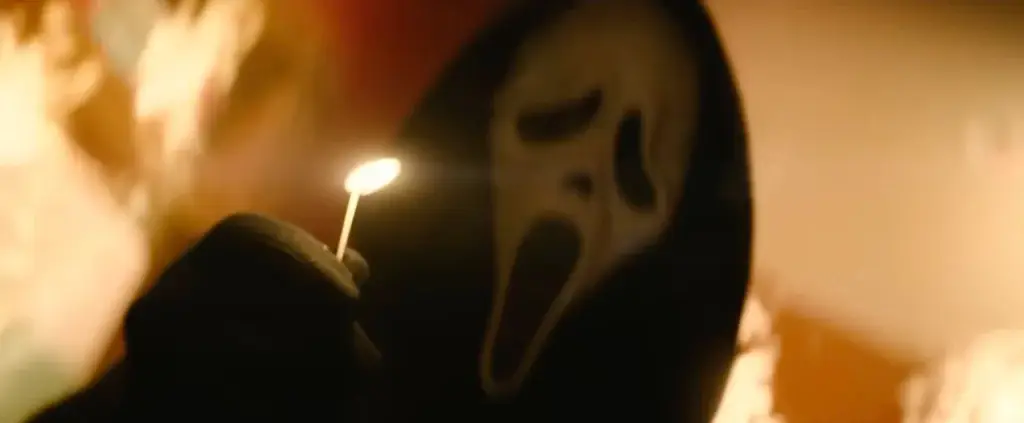
The film opens where it all began. Stu Macher’s old house, now a macabre Airbnb themed for Stab fans, is set ablaze by a new Ghostface. It’s a powerful, almost purifying image, which Williamson uses to draw a line: what came before (New York, the new characters) is only a distant echo. Now we return to the provinces, to a small Midwestern community where Sidney lives with her husband, Mark (Joel McHale, used with measured irony) and daughter, Tatum (Isabel May), a name that already pays homage to the unfortunate friend from the first film.
And it’s here that Scream 7 shines, rediscovering the psychological thriller-feel that distinguished Wes Craven’s first two films. Williamson’s camera, less virtuoso than that of the Radio Silence crew but more attentive to faces and atmospheres, lingers on Sidney’s atavistic fear. She’s no longer the girl running from a killer, but a mother fearing the trauma will be repeated on her daughter’s skin. The references to the first trilogy are constant and explicit: the mother-daughter relationship echoes the shadows of Maureen Prescott, and the past is never truly buried. The screenplay cleverly plays on the concept of “legacy of evil,” suggesting that the demons of Woodsboro are like a latent virus in the town’s DNA.
However, while the film’s emotional core beats strongly, the thriller mechanism is showing some worrying cracks. After the hurricane of violence and pacing of the New York episode, Scream 7 seems to be trying to breathe, but at times it loses its edge. The investigation is more static, relying on the usual gimmicks and a group of suspicious teenagers. Despite McKenna Grace’s excellent performance and Asa Germann’s charm, they lack the charisma of previous generations. They are characters functional to the massacre, caricatures who suffer the plot rather than drive it. Even the return of Mindy and Chad (Jasmin Savoy Brown and Mason Gooding) feels forced, relegated to a cameo that feels more like a throwaway from a previous script than an organic integration into the new film.
But the real Achilles heel, the one that attentive fans will turn their noses up at, is the motivation behind the new Ghostface. Warning, no spoilers, but it’s fair to say that anyone expecting the usual, brilliant Scream-style twist will be disappointed. The final reveal is bland, almost bureaucratic. If in the first films, the killer’s identity was the culmination of a scathing satire on cinema and society, here the explanation seems cobbled together and a simple pretext to justify the massacre. The satirical bite that made the saga famous is missing; the only nod to contemporary times is a superficial use of artificial intelligence and deepfakes, never fully explored.
So, why watch Scream 7? Because despite an uninspired detective story and a deliberately understated narrative, the film holds up thanks to its cultural breadth and the weight of its “old” glories. Neve Campbell isn’t just a final girl; she’s a living monument to an era, and her performance gives the film a gravitas the later installments lacked. Alongside her, Courteney Cox steals the show with an anthology-worthy entrance, while Matthew Lillard’s return as Stu Macher (or a disturbing simulacrum of him) plays with the viewer’s memory in an almost disturbing way, blurring the lines between reality and legend.
Kevin Williamson directs his creation like looking at an old photo album: with affection, with melancholy, but also with the awareness that that time is over. Scream 7 is a film about the burden of memory and the difficulty of moving forward. It’s less funny than its predecessors, less sarcastic, and much darker. It’s a transitional work, perhaps born from the ashes of a more ambitious project, which pleases purists by bringing Sidney back to the forefront but pays the price of not having a clear direction for the future.
It is a homecoming that smells of dust and memories, but perhaps needed to take this step back to figure out how to start over. Was it necessary? Perhaps not. But seeing Neve Campbell face the nightmare once again, with that mixture of fear and determination, is a spectacle that few thrill fans will be able to deny themselves.