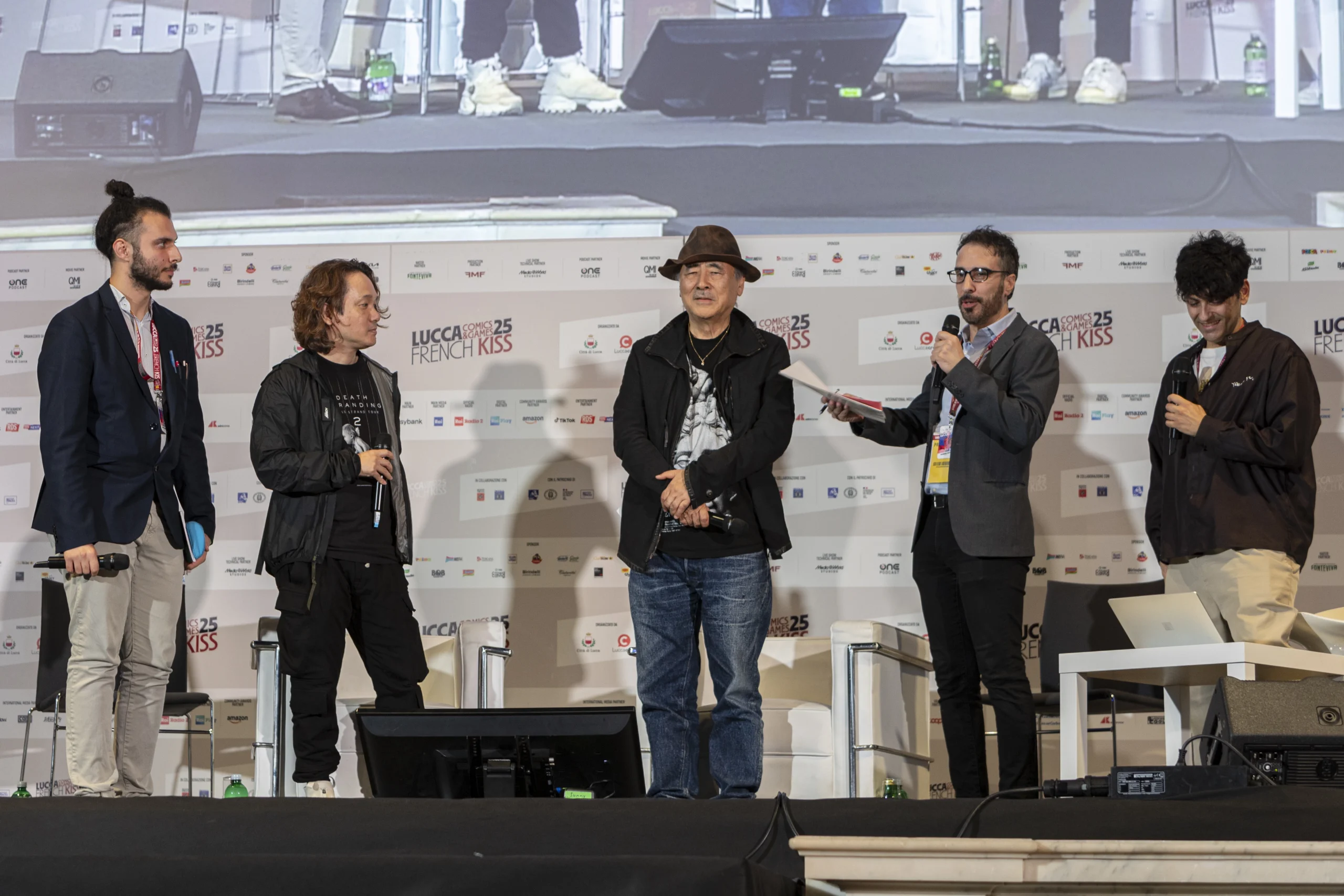
Two visions, two styles, and two eras of Japanese video game and illustration art meet on the same stage at Lucca Comics & Games.
The audience experienced one of the most intense and refined moments with the panel dedicated to Yoji Shinkawa and Yoshitaka Amano; it was a dialogue between the nervous, metallic style of the Metal Gear Solid artist and the dreamlike lightness of the creator who gave face and soul to Final Fantasy.
From the very first moments, the audience sensed the profound harmony between the two masters, despite their seemingly distant artistic backgrounds.
Shinkawa, a longtime collaborator of Hideo Kojima, has built an imagery over the years in which steel meets emotion and every line becomes a psychological narrative.
In contrast, Amano sings of ethereal and suspended elegance, making the line dance until it transfigures reality.
The panel opens with a question as simple as it is universal:
When did your passion for drawing begin, and what influences have guided your art?
Yoshitaka Amano answers:
“I started drawing as a child. I was drawn to realistic drawings more than manga. Then, as I grew up, thanks to friends and encounters, I also became interested in that world. Working at Tatsunoko Productions led me to animation, and there I truly understood the narrative power of images.”

Yoji Shinkawa adds:
“Many Italians grew up with Tatsunoko anime, and I loved them myself. As a child, without knowing it, I was already exposed to the drawings of the master Amano. I remember finding a catalog of his in a bookstore during middle school; at that moment, I realized that those images that had struck me as a child had a specific author. Works like Casshan or The Adventures of Hutch the Honeybee had a profound impact on me—the grace, the dynamism, and the sense of life they conveyed. The things you look at as a child stay with you and become part of you.”
Their words reveal how art often arises from mutual influences and recognitions.
Shinkawa, today a symbol of digital modernity and synthetic drawing, recognizes in Amano one of the roots of his own vision.
Amano, for his part, embodies the memory and continuity of a Japan that fuses art, animation, and visual literature.
When the moderator asks them when they realized that drawing would become a profession and not just a passion, Amano responds with poetic calm; he explains that art, for him, is not a conscious choice but a natural necessity, a path that arises and grows on its own.

Shinkawa, on the other hand, emphasizes how perseverance and discipline make it possible to transform a vocation into a career:
“Working with Kojima requires a continuous exercise of trust and innovation. Every stroke must sustain a complex, yet profoundly human, narrative world.”
The conversation then shifts to the role of contemporary Japanese art and its reception in the West.
Amano reflects on the relationship between beauty and lightness and the importance of dreams in images:
“I’m not interested in representing reality as it is. I want to evoke it, suggest it. Art creates a bridge between the visible and invisible worlds.”
Shinkawa responds by recalling the strength of matter and the concreteness of the line:
“Even when I draw a mecha or a soldier, I always think about what lies behind it: the emotions that move that figure. The line becomes a form of empathy.”
Watching Amano and Shinkawa together in Lucca—the former already a protagonist of the festival in 2024 with The Butterfly Effect, and the latter a symbol of a generation raised on video games and concept art—allows the audience to witness an imaginary passing of the baton between two complementary visions of the Japanese imagination.
In the attentive silence of the room, amid applause and smiles, a shared truth emerges: art, like dreams, transcends all boundaries of medium and generation.
It thrives in the ongoing dialogue between the artist and the viewer, between the narrator and the imaginer.