Once upon a time, there was the idea of making a comedy film. Then someone thought: “What if we didn’t write the jokes? What if we just left everything to hope?”. Welcome to Agata Cristian, the film built on a revolutionary premise: the viewer’s struggle to get to the end credits.
Watching this film, you get the distinct feeling that someone found a time machine and went back thirty years to resurrect a genre we’d finally buried. It’s 2026, but comedy here is stuck in 1995, when simply knocking someone over was enough to make people laugh. Today, however, we’re more demanding. Or at least we try.
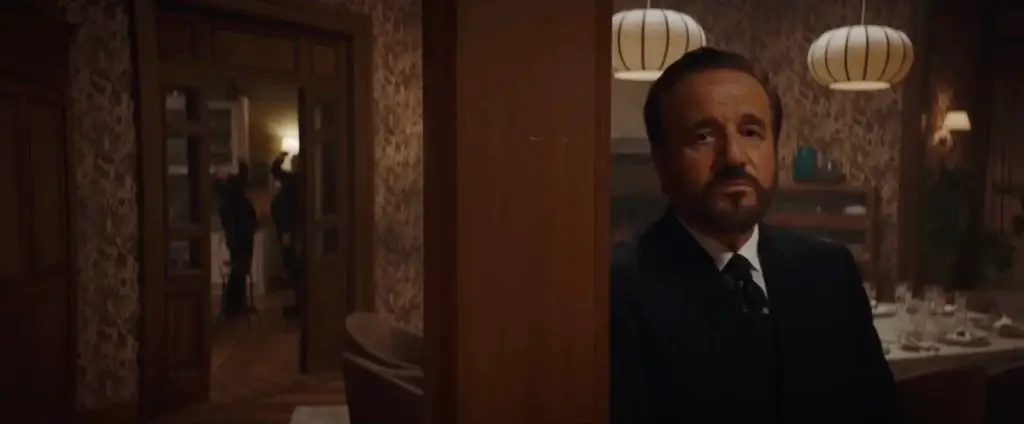
The biggest problem is the lead duo. Lillo and Christian De Sica should be a sure thing together, but instead they seem like two actors who met on the morning of filming, wondering: “What part are you playing?”. He tries to drive the situation home with his verve, while the other seems to be reciting a script written by a relative at his niece’s party. They never click together, like two wheels on the same axle turned in opposite directions.
And then there’s the detective. A man so perceptive that if you ask him, “What time is it?” he looks around as if you’ve just opened a dimensional portal. We arrive at the paradox: the main investigator can’t remember five measly lines from a commercial. Not a piece of Shakespeare, but five lines from a commercial. This should make us laugh. Instead, it makes us reflect on how hard it is in Italy to find convincing actors, but that’s another story.
And now we come to the mystery, because if there’s one thing a detective story must do, it’s engage you, give you clues, and make you feel part of the game. Here, however, nothing. Zero. The clues are a closely guarded secret between the screenwriter and director, probably in a bank vault. Throughout the film, the viewer is left in the dark. Of course! Because the real mystery isn’t who killed whom, but when the next scene in which Lillo is beaten by nature will arrive. A donkey kicking him, an ostrich pecking him: this is the real investigation, the struggle of modern man against the rebellious animal world. It’s National Geographic stuff, if National Geographic were directed by the same people who made Christmas comedies in the 1990s.
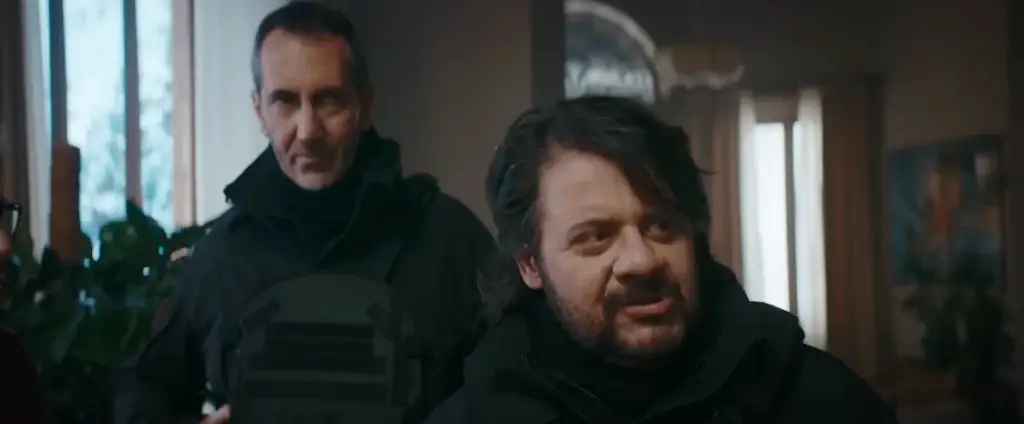
The result is a film that doesn’t know what it wants to be. A comedy? Then it needs jokes. A thriller? Then it needs clues. Instead, it remains half-baked, like those IKEA pieces of furniture missing a crucial screw, leaving you with a bookcase that looks more like a work of contemporary art.
Agata Cristian proves that putting two famous names on a poster isn’t enough to make a film. It’s an hour and a half of good intentions, angry animals, and forgotten investigations. It’s worth watching only if you want to rediscover the pleasure of turning off the television and looking out the window. At least there, the birds don’t attack passersby. Usually.