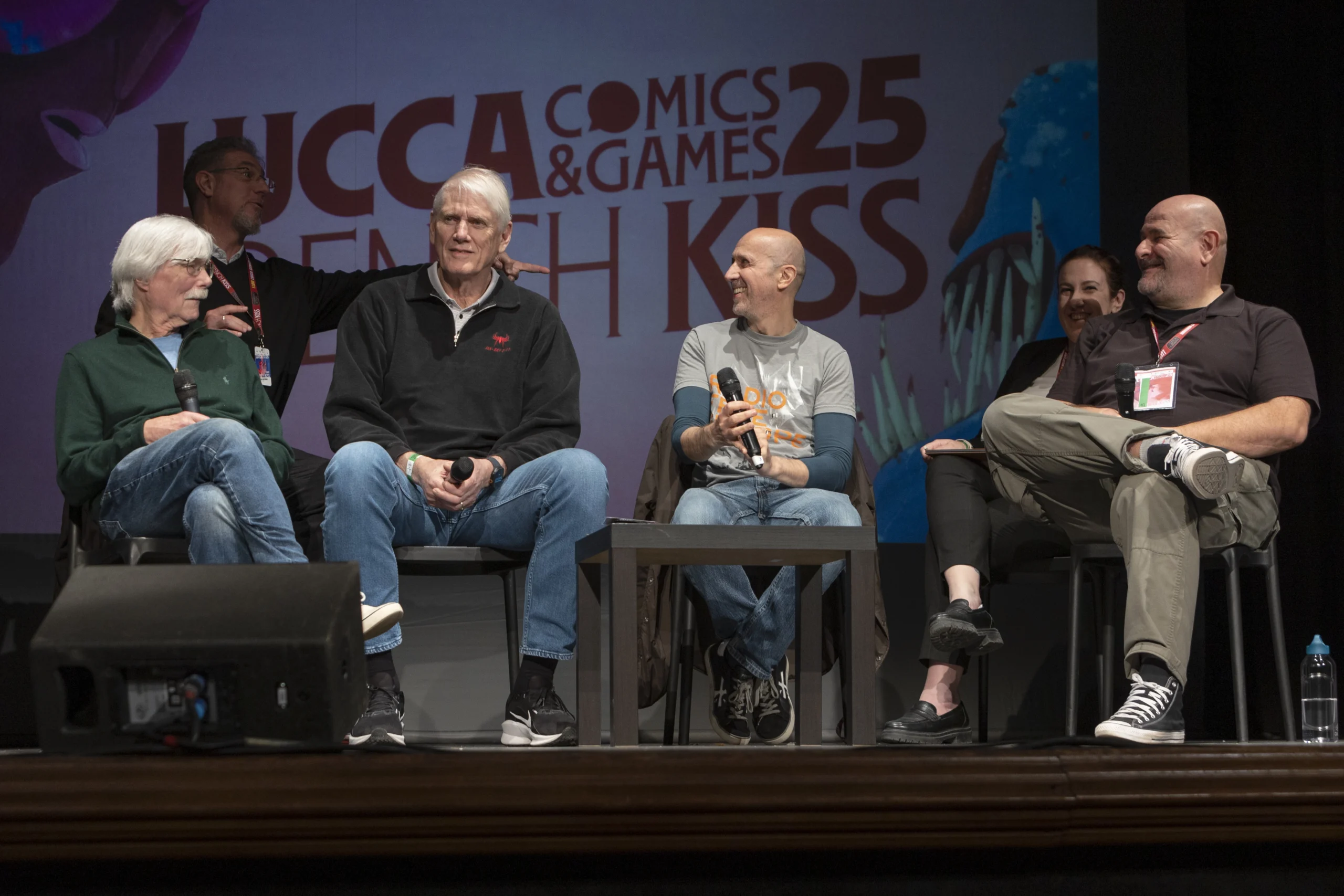
Through behind-the-scenes insights, curiosities, and personal memories, Mike Richardson, CEO of Dark Horse Comics, and David Scroggy, the publisher’s longtime Product Developer, shared a fascinating story about their work exporting and promoting Italian comics to the United States. It is a journey not without challenges, but rich in human encounters and significant moments that helped build a cultural bridge between two profoundly different comics traditions.
Of particular interest were the anecdotes related to Sergio Bonelli, a central and beloved figure in the Italian comics scene. Richardson emotionally recalled his numerous encounters with Bonelli, describing him as a man of great charisma, incredibly generous, and always ready to embrace new ideas and collaborations with curiosity and openness. Richardson further said that his humanity and enthusiasm have remained etched in the memory of anyone fortunate enough to work with him.
During the conversation, there were plenty of opportunities to reflect on the differences between Italian and American comics, from production methods to the relationship with the public, and the narrative and stylistic choices that characterize the two schools. Richardson and Scroggy emphasized how Italian comics maintain a strong connection to tradition and authorial storytelling, while American comics tend to prioritize industry and the market, while maintaining a high level of visual innovation.
A shared admiration for both was Lucca Comics & Games, an event they described as unique for the love and dedication with which it celebrates the world of comics. They expressed great amazement and respect for the passion of the Italian public, capable of transforming each edition of the event into a true celebration of pop culture where professionals and enthusiasts meet on the same level, united by the same passion for the ninth art.

To the question:
“What is the main difference between Italian and American comics? Or, in other words, what is the obstacle the average American reader must overcome to read an Italian comic?”
Mike Richardson:
“So American comics came from newspaper strips, and they were produced in the cheapest way possible, starting out as a preview. So, they printed it on newsprint at a certain size because that’s the number of folds you can get in a sheet of newsprint with a magazine slip on the outside and two staples. So, the American comics business was built on these floppies. So, in the 30s, Superman shows up, and of course that starts the whole superhero craze. And so that has an indelible mark on the comic industry in America. So, if you’re trying to compare it with Italian comics, you can say the differences are format, art-style in many cases, subject matter, etc. Italian comics are very Italian, and if you know comics, you can recognize an Italian comic… They are coming from the different places even though they are all trying to accomplish the same thing: words, and pictures, and panels. … there are differences. I mean, if you really want to look like an American comic you have to study American comics. I don’t think they are as broad, although the breath and width of subject matter has increased over the years. So, there’s definite differences. Just in format there’s differences since you guys don’t do the floppies, which if you think about it, I’ve always said it’s such a silly way to sell a story: you get now 20 pages of story and then you wait a month and it takes 4-6 months to get the whole thing, and then you can just buy it in a graphic novel anyway at the end. … So we avoided the collectors market, and I think that’s to some degree the same thing in Europe in general and in Italy that you can get a book and you don’t have to get the 20 pages and wait another month to get the next chapter, if there is one. Sometimes, the 20 pages are the whole story. So we don’t want to do that ; we want to get books in stores that people will put on their shelf.”

Michele Masiero:
“It’s absolutely all understandable… the point is that we have black-and-white pages, for example. The lack of color is already problematic for this market (the US market, N.D.E.), but let’s say a European comic, even a European comic, is different. Italian comics are very different from French comics. In France, they publish 50-page color hardcovers, whereas here it’s always a 100-page novel with a lot of story to read. We (Bonelli), for example, publish all over the world; our Bonelli comics are everywhere… but it’s actually harder to break into markets because French readers are accustomed to that pace. American readers are accustomed to that pace, so it’s very difficult for a reader who’s used to a certain grammar to be able to get into it… I think only Japanese comics have such enormous global penetration and have managed to conquer even very distant markets.”
Davide Fabbri:
“I imagine you’ve seen French, American, and Italian comics. I understand the question, but one thing I’ll reiterate is that there’s always the issue of visual narration that unites them. And there are small differences; sometimes there are big ones, but ultimately, the mechanism is that of visual narration. Maybe the French use more long shots and more settings, while we Italians (use) a middle ground. The Americans are a bit more rigorous. But it’s true that French and Italians have worked in that market too. So there’s a certain interchangeability.”